Loading...
Searching...
No Matches
FST::Search_SFRS< RETURNTYPE, DIMTYPE, SUBSET, CRITERION, EVALUATOR > Class Template Reference
Implements Sequential_Forward_Retreating_Search and Sequential_Backward_Retreating_Search. More...
#include <search_seq_sfrs.hpp>
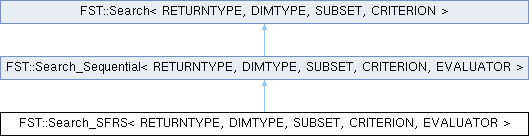
Inheritance diagram for FST::Search_SFRS< RETURNTYPE, DIMTYPE, SUBSET, CRITERION, EVALUATOR >:
Classes | |
| struct | OneSubset |
| Structure to hold [subset,criterion value] temporary solutions in the course of search. More... | |
Public Types | |
| typedef Search_Sequential< RETURNTYPE, DIMTYPE, SUBSET, CRITERION, EVALUATOR > | parent |
| base class alias | |
| typedef parent::parent | grandparent |
| the shared Search base (output detail, result tracker) | |
| typedef std::shared_ptr< EVALUATOR > | PEvaluator |
| shared pointer to the sequential-step evaluator | |
| typedef std::shared_ptr< CRITERION > | PCriterion |
| shared pointer to the criterion the search optimizes | |
| typedef std::shared_ptr< SUBSET > | PSubset |
| shared pointer to a feature subset | |
| Public Types inherited from FST::Search_Sequential< RETURNTYPE, DIMTYPE, SUBSET, CRITERION, EVALUATOR > | |
| typedef Search< RETURNTYPE, DIMTYPE, SUBSET, CRITERION > | parent |
| base class alias | |
| typedef std::shared_ptr< EVALUATOR > | PEvaluator |
| shared pointer to the sequential-step evaluator that implements Step()'s candidate generation and selection | |
| typedef std::shared_ptr< CRITERION > | PCriterion |
| shared pointer to the criterion the search optimizes | |
| typedef std::shared_ptr< SUBSET > | PSubset |
| shared pointer to a feature subset | |
| Public Types inherited from FST::Search< RETURNTYPE, DIMTYPE, SUBSET, CRITERION > | |
| typedef std::shared_ptr< CRITERION > | PCriterion |
| shared pointer to the criterion the search optimizes | |
| typedef std::shared_ptr< SUBSET > | PSubset |
| shared pointer to a feature subset | |
| typedef std::shared_ptr< Result_Tracker< RETURNTYPE, SUBSET > > | PResultTracker |
| shared pointer to the result tracker enabled via enable_result_tracking() | |
| typedef Search_Observer< RETURNTYPE, SUBSET > | OBSERVER |
| the observer interface type this search reports through (see Search_Observer) | |
| typedef std::shared_ptr< OBSERVER > | PObserver |
| shared pointer to an OBSERVER, as set via set_observer() | |
Public Member Functions | |
| Search_SFRS (const PEvaluator evaluator) | |
evaluator must be non-null; direction defaults to FORWARD (SFRS); call set_search_direction(BACKWARD) for SBRS | |
| virtual bool | search (const DIMTYPE target_d, RETURNTYPE &result, const PSubset sub, const PCriterion crit, std::ostream &os=std::cout) override |
| returns found subset + criterion value | |
| void | set_search_direction (const SearchDirection direction) |
| FORWARD selects SFRS, BACKWARD selects SBRS (do not change concurrently to running search()). | |
| SearchDirection | get_search_direction () const |
| the currently configured direction (see set_search_direction()) | |
| void | set_delta (const DIMTYPE delta) |
| optional bound on how far the search's OWN direction advances the frontier: SFRS stops adding features at target_d+delta, SBRS stops removing them at target_d-delta (0 = unrestricted). The retreat in the opposite direction is unconditional and always runs to the hard 1.._n bound, delta or not. No effect when target_d==0 (best-dimensionality search) | |
| DIMTYPE | get_delta () const |
| the currently configured delta bound (see set_delta()) | |
| bool | get_result (const DIMTYPE d, RETURNTYPE &result, PSubset &sub) |
| retrieves temporary solution of cardinality d that had been updated in the course of the last search (if it exists) | |
| virtual std::ostream & | print (std::ostream &os) const override |
| writes a human-readable identification of the search and its configuration; base default writes nothing | |
| Public Member Functions inherited from FST::Search_Sequential< RETURNTYPE, DIMTYPE, SUBSET, CRITERION, EVALUATOR > | |
| Search_Sequential (const PEvaluator evaluator) | |
evaluator must be non-null | |
| bool | Step (const bool forward, RETURNTYPE &result, const PSubset sub, const PCriterion crit, std::ostream &os=std::cout) |
Performs one sequential step: adds (forward) or removes (!forward) the best g-tuple of features, g being the generalization level. | |
| void | set_generalization_level (const DIMTYPE g) |
| optional parameter to enlarge the number of considered candidates (g is the number of features added/removed in one Step) | |
| DIMTYPE | get_generalization_level () const |
| the currently configured generalization level (see set_generalization_level()) | |
| void | enable_initial_subset () |
makes search() start from the caller-supplied contents of its sub argument instead of the concrete method's default (empty set for FORWARD, full set for BACKWARD) | |
| void | disable_initial_subset () |
reverts to the default: incoming sub contents are ignored by search() | |
| bool | initial_subset_enabled () const |
| true if enable_initial_subset() was called (and not since disabled by disable_initial_subset()) | |
| Public Member Functions inherited from FST::Search< RETURNTYPE, DIMTYPE, SUBSET, CRITERION > | |
| void | enable_result_tracking (PResultTracker tracker) |
| assigns a result tracker to the search process, i.e., enables logging of all evaluated subsets for future reuse (re-evaluation, etc.) | |
| void | disable_result_tracking () |
| detaches any result tracker (result_tracker_active() then returns false) | |
| bool | result_tracker_active () const |
| true if a result tracker was assigned via enable_result_tracking() and not since disabled | |
| void | set_output_detail (OutputDetail detail) |
| sets the amount of information that is logged to output stream throughout the course of search | |
| OutputDetail | get_output_detail () const |
| the currently configured output detail level | |
| bool | output_normal () const |
| true unless output detail is SILENT | |
| bool | output_detailed () const |
| true only at the DETAILED output level | |
| void | set_observer (PObserver observer) |
redirects search progress reporting away from the default syncout text output to observer | |
Protected Attributes | |
| SearchDirection | _direction |
| DIMTYPE | _delta |
| frontier restriction around target_d (0 = unrestricted); see set_delta() | |
| std::unique_ptr< OneSubset[]> | bsubs |
| per-cardinality best-known result found in the course of the last search() (index d-1); read by get_result() | |
| DIMTYPE | _n |
| bsubs array size | |
| std::unique_ptr< SUBSET > | pivotsub |
| the subset the next advance continues from: the last subset that became the overall best during the retreat. NOTE the name means something else in Search_DOS, where "pivot" denotes the best-so-far subset - that one is called maxcritsub here | |
| std::unique_ptr< SUBSET > | maxcritsub |
| stores the subset with maximum known crit value | |
| Protected Attributes inherited from FST::Search_Sequential< RETURNTYPE, DIMTYPE, SUBSET, CRITERION, EVALUATOR > | |
| PEvaluator | _evaluator |
| the sequential-step evaluator injected at construction; drives Step()'s candidate generation and best/worst choice | |
| DIMTYPE | _generalization_level |
| number of features added/removed together in one Step() call (see set_generalization_level()) | |
| bool | _initial_subset_enabled |
| by default all concrete search methods ignore the contents of supplied 'PSubset set' and initialize sub according to their definition; if enabled, then (if possible) the search() starts from supplied 'PSubset sub' contents | |
| Protected Attributes inherited from FST::Search< RETURNTYPE, DIMTYPE, SUBSET, CRITERION > | |
| PResultTracker | _tracker |
| the assigned result tracker, or null (see enable_result_tracking()/result_tracker_active()) | |
| OutputDetail | _detail |
| the output detail level set via set_output_detail(); read by output_normal()/output_detailed() | |
| PObserver | _observer |
| the attached progress observer, or null (see set_observer(), report(), report_solution()) | |
Additional Inherited Members | |
| Protected Member Functions inherited from FST::Search< RETURNTYPE, DIMTYPE, SUBSET, CRITERION > | |
| void | report (std::ostream &os, const msgbuf &m) const |
| delivers one pre-formatted progress message: to the observer if attached, otherwise as syncout text to os | |
| void | report_solution (std::ostream &os, const RETURNTYPE value, const SUBSET &sub, const msgbuf &m) const |
| like report(), for sites announcing a new (sub-)solution; fires on_solution instead | |
Detailed Description
template<class RETURNTYPE, typename DIMTYPE, class SUBSET, class CRITERION, class EVALUATOR>
class FST::Search_SFRS< RETURNTYPE, DIMTYPE, SUBSET, CRITERION, EVALUATOR >
class FST::Search_SFRS< RETURNTYPE, DIMTYPE, SUBSET, CRITERION, EVALUATOR >
Implements Sequential_Forward_Retreating_Search and Sequential_Backward_Retreating_Search.
- Note
- By default any initial subset contents are ignored; SFRS starts from empty set and SBRS starts from full set. Call enable_initial_subset() to let the search start from the initial sub contents.
- SFRS is closely related to SFFS, but is more thorough, slower, possibly more suitable if result regularization is to be eventually applied (selection of alternative solution based on secondary criterion), because SFRS evaluates more candidate subsets than SFFS. Concretely, it differs from Search_SFFS in two points: the retreating (backtracking) phase is UNCONDITIONAL, i.e. it always retreats all the way to the opposite cardinality bound instead of stopping at the first non-improving step, and the subset the next advance continues from is updated only on a new overall best, not on every per-cardinality improvement.
- Among subsets of EQUAL criterion value the search prefers the SMALLER one, both when updating the best-so-far used for the target_d==0 (optimize cardinality) answer and, implicitly, in that a per-cardinality record is only replaced by a strictly better value.
- Examples
- demo52t.cpp.
Member Function Documentation
◆ print()
template<class RETURNTYPE, typename DIMTYPE, class SUBSET, class CRITERION, class EVALUATOR>
|
overridevirtual |
writes a human-readable identification of the search and its configuration; base default writes nothing
Reimplemented from FST::Search< RETURNTYPE, DIMTYPE, SUBSET, CRITERION >.
◆ search()
template<class RETURNTYPE, typename DIMTYPE, class SUBSET, class CRITERION, class EVALUATOR>
|
overridevirtual |
returns found subset + criterion value
Implements FST::Search_Sequential< RETURNTYPE, DIMTYPE, SUBSET, CRITERION, EVALUATOR >.
- Examples
- demo52t.cpp.
Member Data Documentation
◆ _direction
template<class RETURNTYPE, typename DIMTYPE, class SUBSET, class CRITERION, class EVALUATOR>
|
protected |
accepted values FORWARD for SFRS or BACKWARD for SBRS
The documentation for this class was generated from the following file:
- /Users/psms/dev/devtest1/_src_search/search_seq_sfrs.hpp
Generated by
 1.17.0