Loading...
Searching...
No Matches
FST::Search_SFFS< RETURNTYPE, DIMTYPE, SUBSET, CRITERION, EVALUATOR > Class Template Reference
Implements Sequential_Forward_Floating_Search and Sequential_Backward_Floating_Search. More...
#include <search_seq_sffs.hpp>
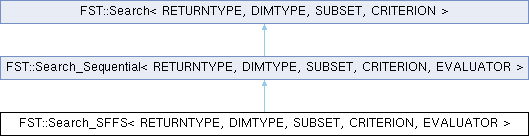
Inheritance diagram for FST::Search_SFFS< RETURNTYPE, DIMTYPE, SUBSET, CRITERION, EVALUATOR >:
Classes | |
| struct | OneSubset |
| Structure to hold [subset,criterion value] temporary solutions in the course of search. More... | |
Public Types | |
| typedef Search_Sequential< RETURNTYPE, DIMTYPE, SUBSET, CRITERION, EVALUATOR > | parent |
| base class alias | |
| typedef parent::parent | grandparent |
| the shared Search base (output detail, result tracker) | |
| typedef std::shared_ptr< EVALUATOR > | PEvaluator |
| shared pointer to the sequential-step evaluator | |
| typedef std::shared_ptr< CRITERION > | PCriterion |
| shared pointer to the criterion the search optimizes | |
| typedef std::shared_ptr< SUBSET > | PSubset |
| shared pointer to a feature subset | |
| Public Types inherited from FST::Search_Sequential< RETURNTYPE, DIMTYPE, SUBSET, CRITERION, EVALUATOR > | |
| typedef Search< RETURNTYPE, DIMTYPE, SUBSET, CRITERION > | parent |
| base class alias | |
| typedef std::shared_ptr< EVALUATOR > | PEvaluator |
| shared pointer to the sequential-step evaluator that implements Step()'s candidate generation and selection | |
| typedef std::shared_ptr< CRITERION > | PCriterion |
| shared pointer to the criterion the search optimizes | |
| typedef std::shared_ptr< SUBSET > | PSubset |
| shared pointer to a feature subset | |
| Public Types inherited from FST::Search< RETURNTYPE, DIMTYPE, SUBSET, CRITERION > | |
| typedef std::shared_ptr< CRITERION > | PCriterion |
| shared pointer to the criterion the search optimizes | |
| typedef std::shared_ptr< SUBSET > | PSubset |
| shared pointer to a feature subset | |
| typedef std::shared_ptr< Result_Tracker< RETURNTYPE, SUBSET > > | PResultTracker |
| shared pointer to the result tracker enabled via enable_result_tracking() | |
| typedef Search_Observer< RETURNTYPE, SUBSET > | OBSERVER |
| the observer interface type this search reports through (see Search_Observer) | |
| typedef std::shared_ptr< OBSERVER > | PObserver |
| shared pointer to an OBSERVER, as set via set_observer() | |
Public Member Functions | |
| Search_SFFS (const PEvaluator evaluator) | |
evaluator must be non-null; direction defaults to FORWARD (SFFS); call set_search_direction(BACKWARD) for SBFS | |
| virtual bool | search (const DIMTYPE target_d, RETURNTYPE &result, const PSubset sub, const PCriterion crit, std::ostream &os=std::cout) override |
| returns found subset + criterion value | |
| void | set_search_direction (const SearchDirection direction) |
| FORWARD selects SFFS, BACKWARD selects SBFS (do not change concurrently to a running search()). | |
| SearchDirection | get_search_direction () const |
| the currently configured direction (see set_search_direction()) | |
| void | set_delta (const DIMTYPE delta) |
| optional parameter to restrict search extent: bounds the floating frontier to at most target_d+delta features forward and at least target_d-delta backward (0 = unrestricted, the classic full floating frontier); has no effect when target_d==0 (best-dimensionality search) | |
| DIMTYPE | get_delta () const |
| the currently configured delta bound (see set_delta()) | |
| bool | get_result (const DIMTYPE d, RETURNTYPE &result, PSubset &sub) |
| retrieves temporary solution of cardinality d that had been updated in the course of the last search (if it exists) | |
| virtual std::ostream & | print (std::ostream &os) const override |
| writes a human-readable identification of the search and its configuration; base default writes nothing | |
| Public Member Functions inherited from FST::Search_Sequential< RETURNTYPE, DIMTYPE, SUBSET, CRITERION, EVALUATOR > | |
| Search_Sequential (const PEvaluator evaluator) | |
evaluator must be non-null | |
| bool | Step (const bool forward, RETURNTYPE &result, const PSubset sub, const PCriterion crit, std::ostream &os=std::cout) |
Performs one sequential step: adds (forward) or removes (!forward) the best g-tuple of features, g being the generalization level. | |
| void | set_generalization_level (const DIMTYPE g) |
| optional parameter to enlarge the number of considered candidates (g is the number of features added/removed in one Step) | |
| DIMTYPE | get_generalization_level () const |
| the currently configured generalization level (see set_generalization_level()) | |
| void | enable_initial_subset () |
makes search() start from the caller-supplied contents of its sub argument instead of the concrete method's default (empty set for FORWARD, full set for BACKWARD) | |
| void | disable_initial_subset () |
reverts to the default: incoming sub contents are ignored by search() | |
| bool | initial_subset_enabled () const |
| true if enable_initial_subset() was called (and not since disabled by disable_initial_subset()) | |
| Public Member Functions inherited from FST::Search< RETURNTYPE, DIMTYPE, SUBSET, CRITERION > | |
| void | enable_result_tracking (PResultTracker tracker) |
| assigns a result tracker to the search process, i.e., enables logging of all evaluated subsets for future reuse (re-evaluation, etc.) | |
| void | disable_result_tracking () |
| detaches any result tracker (result_tracker_active() then returns false) | |
| bool | result_tracker_active () const |
| true if a result tracker was assigned via enable_result_tracking() and not since disabled | |
| void | set_output_detail (OutputDetail detail) |
| sets the amount of information that is logged to output stream throughout the course of search | |
| OutputDetail | get_output_detail () const |
| the currently configured output detail level | |
| bool | output_normal () const |
| true unless output detail is SILENT | |
| bool | output_detailed () const |
| true only at the DETAILED output level | |
| void | set_observer (PObserver observer) |
redirects search progress reporting away from the default syncout text output to observer | |
Protected Attributes | |
| SearchDirection | _direction |
| DIMTYPE | _delta |
| frontier restriction around target_d (0 = unrestricted); see set_delta() | |
| std::unique_ptr< OneSubset[]> | bsubs |
| per-cardinality best-known result found in the course of the last search() (index d-1); read by get_result() | |
| DIMTYPE | _n |
| bsubs array size | |
| std::unique_ptr< SUBSET > | pivotsub |
| the subset the next forward step continues from: the deepest backtracking result that improved its cardinality's record. NOTE the name means something else in Search_DOS, where "pivot" denotes the best-so-far subset - that one is called maxcritsub here | |
| std::unique_ptr< SUBSET > | maxcritsub |
| stores the subset with maximum known crit value | |
| Protected Attributes inherited from FST::Search_Sequential< RETURNTYPE, DIMTYPE, SUBSET, CRITERION, EVALUATOR > | |
| PEvaluator | _evaluator |
| the sequential-step evaluator injected at construction; drives Step()'s candidate generation and best/worst choice | |
| DIMTYPE | _generalization_level |
| number of features added/removed together in one Step() call (see set_generalization_level()) | |
| bool | _initial_subset_enabled |
| by default all concrete search methods ignore the contents of supplied 'PSubset set' and initialize sub according to their definition; if enabled, then (if possible) the search() starts from supplied 'PSubset sub' contents | |
| Protected Attributes inherited from FST::Search< RETURNTYPE, DIMTYPE, SUBSET, CRITERION > | |
| PResultTracker | _tracker |
| the assigned result tracker, or null (see enable_result_tracking()/result_tracker_active()) | |
| OutputDetail | _detail |
| the output detail level set via set_output_detail(); read by output_normal()/output_detailed() | |
| PObserver | _observer |
| the attached progress observer, or null (see set_observer(), report(), report_solution()) | |
Additional Inherited Members | |
| Protected Member Functions inherited from FST::Search< RETURNTYPE, DIMTYPE, SUBSET, CRITERION > | |
| void | report (std::ostream &os, const msgbuf &m) const |
| delivers one pre-formatted progress message: to the observer if attached, otherwise as syncout text to os | |
| void | report_solution (std::ostream &os, const RETURNTYPE value, const SUBSET &sub, const msgbuf &m) const |
| like report(), for sites announcing a new (sub-)solution; fires on_solution instead | |
Detailed Description
template<class RETURNTYPE, typename DIMTYPE, class SUBSET, class CRITERION, class EVALUATOR>
class FST::Search_SFFS< RETURNTYPE, DIMTYPE, SUBSET, CRITERION, EVALUATOR >
class FST::Search_SFFS< RETURNTYPE, DIMTYPE, SUBSET, CRITERION, EVALUATOR >
Implements Sequential_Forward_Floating_Search and Sequential_Backward_Floating_Search.
- Note
- By default any initial subset contents are ignored; SFFS starts from empty set and SBFS starts from full set. Call enable_initial_subset() to let the search start from the initial sub contents.
- This implementation follows the original SFFS definition closely. See Search_SFRS for a closely related, slower, but more thorough method.
- Among subsets of EQUAL criterion value the search prefers the SMALLER one, both when updating the best-so-far used for the target_d==0 (optimize cardinality) answer and, implicitly, in that a per-cardinality record is only replaced by a strictly better value.
- Examples
- demo55.cpp.
Member Function Documentation
◆ print()
template<class RETURNTYPE, typename DIMTYPE, class SUBSET, class CRITERION, class EVALUATOR>
|
overridevirtual |
writes a human-readable identification of the search and its configuration; base default writes nothing
Reimplemented from FST::Search< RETURNTYPE, DIMTYPE, SUBSET, CRITERION >.
◆ search()
template<class RETURNTYPE, typename DIMTYPE, class SUBSET, class CRITERION, class EVALUATOR>
|
overridevirtual |
returns found subset + criterion value
Implements FST::Search_Sequential< RETURNTYPE, DIMTYPE, SUBSET, CRITERION, EVALUATOR >.
- Examples
- demo55.cpp.
Member Data Documentation
◆ _direction
template<class RETURNTYPE, typename DIMTYPE, class SUBSET, class CRITERION, class EVALUATOR>
|
protected |
accepted values FORWARD for SFFS or BACKWARD for SBFS
The documentation for this class was generated from the following file:
- /Users/psms/dev/devtest1/_src_search/search_seq_sffs.hpp
Generated by
 1.17.0