Loading...
Searching...
No Matches
Public Types |
Public Member Functions |
Private Member Functions |
Private Attributes |
List of all members
FST::Criterion_Subset_Size< RETURNTYPE, SUBSET > Class Template Reference
Returns the (positive) subset size sub->get_d() - since FST4 searches maximize, this rates LARGER subsets higher. Wrap in Criterion_Negative to favor smaller subsets instead. More...
#include <criterion_subsetsize.hpp>
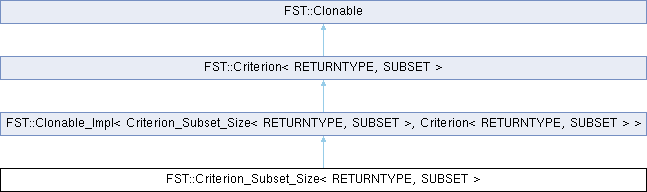
Inheritance diagram for FST::Criterion_Subset_Size< RETURNTYPE, SUBSET >:
Public Types | |
| typedef Clonable_Impl< Criterion_Subset_Size, Criterion< RETURNTYPE, SUBSET > > | parent_impl |
| implements clone(); sharing/stateless_clone throw in Criterion | |
| typedef std::shared_ptr< SUBSET > | PSubset |
| shared pointer to the feature subset being evaluated | |
| Public Types inherited from FST::Criterion< RETURNTYPE, SUBSET > | |
| typedef std::shared_ptr< SUBSET > | PSubset |
| shared pointer to the feature subset being evaluated | |
Public Member Functions | |
| virtual bool | evaluate (RETURNTYPE &result, const PSubset sub) override |
| Scores the given feature subset; higher is better (FST4 searches maximize). | |
| virtual std::ostream & | print (std::ostream &os) const override |
| writes a human-readable identification of the object; base default writes nothing | |
| Public Member Functions inherited from FST::Clonable_Impl< Criterion_Subset_Size< RETURNTYPE, SUBSET >, Criterion< RETURNTYPE, SUBSET > > | |
| Criterion< RETURNTYPE, SUBSET > * | clone () const override |
| dispatches to the DEEP_KIND mechanism (default CLONE_DEEP: Derived's copy-constructor) | |
| Criterion< RETURNTYPE, SUBSET > * | sharing_clone () const override |
| dispatches to the SHARING_KIND mechanism (default CLONE_INHERIT: defers to Base, which throws by family convention) | |
| Criterion< RETURNTYPE, SUBSET > * | stateless_clone () const override |
| dispatches to the STATELESS_KIND mechanism (default CLONE_INHERIT: defers to Base, which throws by family convention) | |
| Public Member Functions inherited from FST::Criterion< RETURNTYPE, SUBSET > | |
| virtual bool | is_monotonic () const |
| Criterion * | sharing_clone () const override |
| Criterion * | stateless_clone () const override |
| Public Member Functions inherited from FST::Clonable | |
| bool | is_clone () const |
| bool | is_sharing () const |
| true if this instance is a sharing_clone() result (referencing, not owning, the source's structures) | |
| bool | is_sharing_clone () const |
| true if this instance is BOTH a clone and sharing – i.e. specifically a sharing_clone() result, not a clone()/stateless_clone() one | |
Private Member Functions | |
| Criterion_Subset_Size (const Criterion_Subset_Size &css) | |
| Copy-constructor; the class carries no state of its own beyond what parent_impl copies. | |
Private Attributes | |
| friend | parent_impl |
Additional Inherited Members | |
| Protected Member Functions inherited from FST::Clonable | |
| void | set_cloned (const bool cloned=true) |
| marks/unmarks this instance as a clone; call from clone()/stateless_clone() overrides (Clonable_Impl does this automatically) | |
| void | set_sharing (const bool sharing=true) |
| marks/unmarks this instance as sharing (see is_sharing()) | |
| void | set_sharing_cloned (const bool cloned=true, const bool sharing=true) |
| sets both flags at once; call from sharing_clone() overrides (Clonable_Impl does this automatically) | |
Detailed Description
template<class RETURNTYPE, class SUBSET>
class FST::Criterion_Subset_Size< RETURNTYPE, SUBSET >
class FST::Criterion_Subset_Size< RETURNTYPE, SUBSET >
Returns the (positive) subset size sub->get_d() - since FST4 searches maximize, this rates LARGER subsets higher. Wrap in Criterion_Negative to favor smaller subsets instead.
This trivial criterion is intended as secondary criterion only to be used in conjunction with Result_Tracker_Regularizer, implementing feature selection regularization (improvement of feature selection generalization ability and result robustness) as described in paper "Somol, Grim, Pudil: The Problem of Fragile Feature Subset Preference in Feature Selection Methods and A Proposal of Algorithmic Workaround. In Proc. ICPR 2010. IEEE Computer Society, 2010". In the fst4 command-line tool this is what --regularize-by subsetsize selects, together with --regularize-margins and --tracker regularizer.
- Note
- Unlike the model-based criteria, which score the raw marker set they are handed and therefore read Subset::get_d_raw(), this one reads Subset::get_d(): the count of currently selected features EXCLUDING frozen ones, independent of the forward/backward search mode. That is the subset size the search itself manipulates, which is the quantity the regularization trade-off is about.
- Examples
- demo52t.cpp.
Member Function Documentation
◆ evaluate()
template<class RETURNTYPE, class SUBSET>
|
inlineoverridevirtual |
Scores the given feature subset; higher is better (FST4 searches maximize).
- Parameters
-
result set to the criterion value on success; left unspecified on failure sub the (fixed) subset to evaluate – only its selected features are read
- Returns
- false if the subset cannot be evaluated at all (e.g. too small for the model, or singular statistics). This is NOT a per-candidate reject: callers treat it as fatal for the current search step or run – the sequential-step candidate evaluator marks its whole batch failed, streaming searches abort, and Branch & Bound throws. A criterion that can legitimately be undefined on some subsets must guard against reaching those subsets another way (e.g. a minimum-subset-size constraint), not by relying on evaluate() to skip them.
Implements FST::Criterion< RETURNTYPE, SUBSET >.
◆ print()
template<class RETURNTYPE, class SUBSET>
|
inlineoverridevirtual |
writes a human-readable identification of the object; base default writes nothing
Reimplemented from FST::Clonable.
Member Data Documentation
◆ parent_impl
template<class RETURNTYPE, class SUBSET>
|
private |
grants Clonable_Impl access to the copy-constructor
The documentation for this class was generated from the following file:
- /Users/psms/dev/devtest1/_src_criteria/criterion_subsetsize.hpp
Generated by
 1.17.0