Loading...
Searching...
No Matches
Public Types |
Public Member Functions |
Private Member Functions |
Private Attributes |
List of all members
FST::Result_Tracker_Regularizer< RETURNTYPE, IDXTYPE, DIMTYPE, SUBSET, CRITERION > Class Template Reference
Collects multiple results. Enables eventual selection of alternative solution based on secondary criterion. More...
#include <result_tracker_regularizer.hpp>
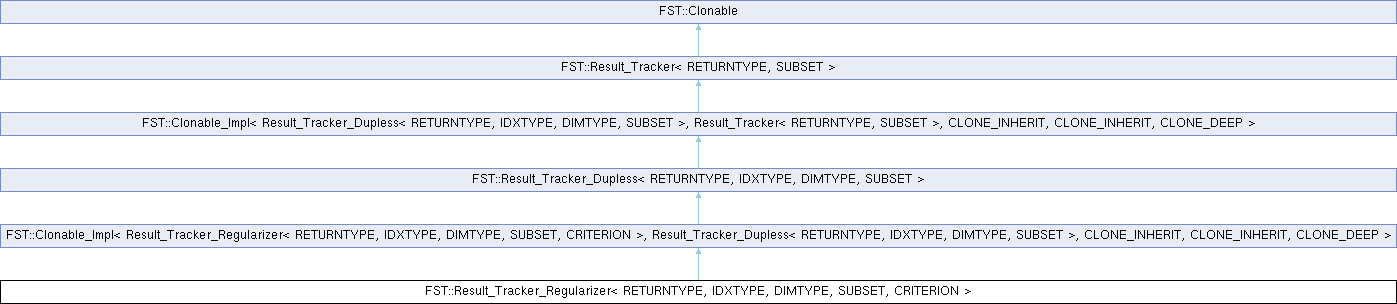
Inheritance diagram for FST::Result_Tracker_Regularizer< RETURNTYPE, IDXTYPE, DIMTYPE, SUBSET, CRITERION >:
Public Types | |
| typedef Result_Tracker_Dupless< RETURNTYPE, IDXTYPE, DIMTYPE, SUBSET > | parent |
| base class alias | |
| typedef Clonable_Impl< Result_Tracker_Regularizer, parent, CLONE_INHERIT, CLONE_INHERIT, CLONE_DEEP > | parent_impl |
| implements stateless_clone() via Clonable_Impl; clone()/sharing_clone() defer to Result_Tracker's throwing defaults (see CLONE_INHERIT) | |
| typedef parent::ResultRec | ResultRec |
| one tracked [value,subset] result record, as defined by Result_Tracker | |
| typedef ResultRec * | PResultRec |
| raw pointer to a ResultRec | |
| typedef std::shared_ptr< SUBSET > | PSubset |
| shared pointer to a feature subset | |
| typedef std::shared_ptr< CRITERION > | PCriterion |
| shared pointer to a criterion (the secondary criterion used to re-rank tracked results) | |
| Public Types inherited from FST::Result_Tracker_Dupless< RETURNTYPE, IDXTYPE, DIMTYPE, SUBSET > | |
| typedef Result_Tracker< RETURNTYPE, SUBSET > | parent |
| the abstract Result_Tracker interface this class implements | |
| typedef Clonable_Impl< Result_Tracker_Dupless, parent, CLONE_INHERIT, CLONE_INHERIT, CLONE_DEEP > | parent_impl |
| implements stateless_clone() via the copy-constructor (CLONE_DEEP); clone()/sharing_clone() are inherited from Result_Tracker, which throws for both | |
| typedef parent::ResultRec | ResultRec |
| see Result_Tracker::ResultRec | |
| typedef parent::PResultRec | PResultRec |
| see Result_Tracker::PResultRec | |
| typedef std::shared_ptr< SUBSET > | PSubset |
| typedef std::list< ResultRec >::const_iterator | CONSTRESULTSITER |
| read-only iterator over results, for use by subclasses/friends inspecting the collected results | |
| typedef std::list< ResultRec >::iterator | RESULTSITER |
| mutable iterator over results, as returned by begin()/end() | |
| Public Types inherited from FST::Result_Tracker< RETURNTYPE, SUBSET > | |
| typedef std::shared_ptr< SUBSET > | PSubset |
| shared pointer to a tracked feature subset | |
| typedef ResultRec * | PResultRec |
| raw pointer to a ResultRec, as used by get_first()/get_next() iteration | |
Public Member Functions | |
| Result_Tracker_Regularizer (const IDXTYPE capacity_limit=0) | |
capacity_limit forwarded to Result_Tracker_Dupless (0 = unlimited) | |
| Result_Tracker_Regularizer (const Result_Tracker_Regularizer &rtr) | |
| the copy starts with a fresh (non-searching) equivalence-group cursor; _crit/_prevmax/_iter are not copied | |
| virtual bool | optimize_within_margin (const RETURNTYPE margin, RETURNTYPE &result1, RETURNTYPE &result2, PSubset &sub, const PCriterion crit) |
Re-ranks the tracked results within margin of the best tracked (primary) value by a secondary crit, returning the one crit ranks highest. | |
| virtual bool | optimize_within_first_equivalence_group (RETURNTYPE &result1, RETURNTYPE &result2, PSubset &sub, const PCriterion crit) |
Starts a group-by-group scan: returns the subset of the first equivalence group (the tracked subsets sharing the highest primary criterion value) that crit ranks highest. | |
| virtual bool | optimize_within_next_equivalence_group (RETURNTYPE &result1, RETURNTYPE &result2, PSubset &sub) |
| Continues the scan started by optimize_within_first_equivalence_group(): returns the best subset of the next equivalence group (the next lower primary criterion value), ranked by the criterion given there. | |
| virtual std::ostream & | print (std::ostream &os) const override |
| writes a human-readable identification of the object; base default writes nothing | |
| Public Member Functions inherited from FST::Clonable_Impl< Result_Tracker_Regularizer< RETURNTYPE, IDXTYPE, DIMTYPE, SUBSET, CRITERION >, Result_Tracker_Dupless< RETURNTYPE, IDXTYPE, DIMTYPE, SUBSET >, CLONE_INHERIT, CLONE_INHERIT, CLONE_DEEP > | |
| Result_Tracker_Dupless< RETURNTYPE, IDXTYPE, DIMTYPE, SUBSET > * | clone () const override |
| dispatches to the DEEP_KIND mechanism (default CLONE_DEEP: Derived's copy-constructor) | |
| Result_Tracker_Dupless< RETURNTYPE, IDXTYPE, DIMTYPE, SUBSET > * | sharing_clone () const override |
| dispatches to the SHARING_KIND mechanism (default CLONE_INHERIT: defers to Base, which throws by family convention) | |
| Result_Tracker_Dupless< RETURNTYPE, IDXTYPE, DIMTYPE, SUBSET > * | stateless_clone () const override |
| dispatches to the STATELESS_KIND mechanism (default CLONE_INHERIT: defers to Base, which throws by family convention) | |
| Public Member Functions inherited from FST::Result_Tracker_Dupless< RETURNTYPE, IDXTYPE, DIMTYPE, SUBSET > | |
| Result_Tracker_Dupless (const IDXTYPE capacity_limit=0) | |
| Result_Tracker_Dupless (const Result_Tracker_Dupless &rtd) | |
copies the configuration (margin, cardinality restriction, capacity limit) only; the results list is NOT copied (starts empty) – this constructor backs stateless_clone() (CLONE_DEEP), which by contract does not replicate exact object state | |
| virtual bool | add (const RETURNTYPE value, const PSubset sub) override |
Offers one (value, subset) result for inclusion; sub is copied, the caller keeps ownership of its own object. | |
| virtual void | clear () override |
| discards all recorded results | |
| virtual std::size_t | size () const override |
| number of results currently held (std::size_t rather than 'long': on LLP64 platforms 'long' is 32 bits and would narrow the container's own size type) | |
| virtual std::size_t | size (const RETURNTYPE margin) const |
number of currently held results whose value is within margin of the best (first, highest-value) held result | |
| virtual bool | get_first (PResultRec &r) override |
| starts iteration at the best held result; false if nothing is held. The returned pointer refers into this tracker's own storage and is invalidated by add(), join() and clear() | |
| virtual bool | get_next (PResultRec &r) override |
| hands out the next result in descending-value order; false when the iteration is exhausted. There is one shared cursor per tracker, so nested or concurrent iterations of the same tracker interfere | |
| virtual void | join (Result_Tracker< RETURNTYPE, SUBSET > &src) override |
merges the results held by src into this tracker, keeping the ordering and skipping duplicates exactly as add() does, then re-applies the capacity limit and the margin to the merged list. Consumes src's iteration cursor; src itself is left unchanged | |
| void | set_inclusion_margin (const RETURNTYPE margin=0) |
| restrict adding to only subsets with criterion value within given distance (margin) from best known | |
| void | set_inclusion_cardinality_restriction (const DIMTYPE d) |
| for d>0 restricts adding only to subsets of size d, for d=0 subset size restriction is removed | |
| RESULTSITER | begin () |
| iterator to the best (first) held result | |
| RESULTSITER | end () |
| iterator past the last held result | |
| Public Member Functions inherited from FST::Result_Tracker< RETURNTYPE, SUBSET > | |
| Result_Tracker (const Result_Tracker &rt) | |
| copies the output-detail setting only – concrete trackers copy their own collected results separately | |
| Result_Tracker * | clone () const override |
| Result_Tracker * | sharing_clone () const override |
| void | set_output_detail (OutputDetail detail) |
| sets the amount of information that is logged to output stream throughout the course of search | |
| OutputDetail | get_output_detail () const |
| the currently configured output detail level | |
| bool | output_normal () const |
| true unless output detail is SILENT | |
| bool | output_detailed () const |
| true only at the DETAILED output level | |
| Public Member Functions inherited from FST::Clonable | |
| bool | is_clone () const |
| bool | is_sharing () const |
| true if this instance is a sharing_clone() result (referencing, not owning, the source's structures) | |
| bool | is_sharing_clone () const |
| true if this instance is BOTH a clone and sharing – i.e. specifically a sharing_clone() result, not a clone()/stateless_clone() one | |
Private Member Functions | |
| bool | optimize_within_equivalence_group (RETURNTYPE &result1, RETURNTYPE &result2, PSubset &sub) |
| building block for optimize_within_*_equivalence_group | |
Private Attributes | |
| PCriterion | _crit |
| the secondary criterion set by optimize_within_first_equivalence_group(), reused by subsequent optimize_within_next_equivalence_group() calls | |
| RETURNTYPE | _prevmax |
| the primary value of the equivalence group currently being scanned; helper of optimize_within_equivalence_group() | |
| parent::CONSTRESULTSITER | _iter |
| cursor into the tracked results list, carried across optimize_within_*_equivalence_group() calls so scanning resumes where the previous call left off; adding to the tracker during a scan may invalidate it | |
| bool | _searching |
| true while an equivalence-group scan is in progress, i.e. optimize_within_next_equivalence_group() may still find further groups | |
Additional Inherited Members | |
| Protected Member Functions inherited from FST::Clonable | |
| void | set_cloned (const bool cloned=true) |
| marks/unmarks this instance as a clone; call from clone()/stateless_clone() overrides (Clonable_Impl does this automatically) | |
| void | set_sharing (const bool sharing=true) |
| marks/unmarks this instance as sharing (see is_sharing()) | |
| void | set_sharing_cloned (const bool cloned=true, const bool sharing=true) |
| sets both flags at once; call from sharing_clone() overrides (Clonable_Impl does this automatically) | |
| Protected Attributes inherited from FST::Result_Tracker_Dupless< RETURNTYPE, IDXTYPE, DIMTYPE, SUBSET > | |
| std::list< ResultRec > | results |
| held results, sorted descending by value (ties broken toward the smaller subset); see add() for the exact insertion/dedup/trim rule | |
| RETURNTYPE | _margin |
| set via set_inclusion_margin(); 0 = no margin restriction | |
| DIMTYPE | _restrict_to_d |
| set via set_inclusion_cardinality_restriction(); 0 = no subset-size restriction | |
| const IDXTYPE | _capacity_limit |
| set by the constructor; 0 = unlimited | |
| Protected Attributes inherited from FST::Result_Tracker< RETURNTYPE, SUBSET > | |
| OutputDetail | _detail |
| the output detail level set via set_output_detail(); read by output_normal()/output_detailed() | |
Detailed Description
template<class RETURNTYPE, typename IDXTYPE, typename DIMTYPE, class SUBSET, class CRITERION>
class FST::Result_Tracker_Regularizer< RETURNTYPE, IDXTYPE, DIMTYPE, SUBSET, CRITERION >
class FST::Result_Tracker_Regularizer< RETURNTYPE, IDXTYPE, DIMTYPE, SUBSET, CRITERION >
Collects multiple results. Enables eventual selection of alternative solution based on secondary criterion.
Enables selecting a different subset than the one yielded by the search procedure, e.g., with the aim to reduce overfitting or to take into account known feature acquisition cost.
The idea is to consider all known subsets with criterion value close enough to the maximum as effectively equal - then another criterion is used to choose among those alternative solutions. This technique can improve generalization/robustness and reduce overfitting, as well as open up other possibilities, like preferring a subset being almost equal to the primarily selected, but with considerably lower feature value acquisition cost, etc. For details see paper "Somol, Grim, Pudil: The Problem of Fragile Feature Subset Preference in Feature Selection Methods and A Proposal of Algorithmic Workaround. In Proc. ICPR 2010. IEEE Computer Society, 2010".
- Examples
- demo52t.cpp.
Member Function Documentation
◆ optimize_within_first_equivalence_group()
template<class RETURNTYPE, typename IDXTYPE, typename DIMTYPE, class SUBSET, class CRITERION>
|
virtual |
Starts a group-by-group scan: returns the subset of the first equivalence group (the tracked subsets sharing the highest primary criterion value) that crit ranks highest.
crit must be non-null and already initialize()d, sub must be non-null. Ties in crit are broken in favor of the smaller cardinality. crit is remembered for the subsequent optimize_within_next_equivalence_group() calls.
- Returns
- false if the tracker holds no result, or if a
critevaluation failed; the scan is then not in progress and the next-group call returns false too.
◆ optimize_within_margin()
template<class RETURNTYPE, typename IDXTYPE, typename DIMTYPE, class SUBSET, class CRITERION>
|
virtual |
Re-ranks the tracked results within margin of the best tracked (primary) value by a secondary crit, returning the one crit ranks highest.
Assumes the tracked list is sorted with the best (primary) value first, as Result_Tracker_Dupless maintains it, and stops scanning once a tracked value drops below best_primary_value - margin. Among the subsets within the margin, picks the one with the highest crit value, breaking ties in favor of the smaller cardinality.
- Parameters
-
margin non-negative margin (0 restricts the scan to the primary-best value only). result1 receives the primary (originally tracked) value of the returned subset. result2 receives the secondary crit'svalue of the returned subset.sub receives the chosen subset. crit the secondary criterion used to re-rank candidates within margin; must be non-null and already initialize()d.
- Returns
- false if the tracker is empty or a
critevaluation fails.
◆ optimize_within_next_equivalence_group()
template<class RETURNTYPE, typename IDXTYPE, typename DIMTYPE, class SUBSET, class CRITERION>
|
virtual |
Continues the scan started by optimize_within_first_equivalence_group(): returns the best subset of the next equivalence group (the next lower primary criterion value), ranked by the criterion given there.
- Returns
- false if no scan is in progress (the first-group call was never made, failed, or the previous call consumed the last group), or if a criterion evaluation failed.
◆ print()
template<class RETURNTYPE, typename IDXTYPE, typename DIMTYPE, class SUBSET, class CRITERION>
|
inlineoverridevirtual |
writes a human-readable identification of the object; base default writes nothing
Reimplemented from FST::Result_Tracker_Dupless< RETURNTYPE, IDXTYPE, DIMTYPE, SUBSET >.
The documentation for this class was generated from the following file:
- /Users/psms/dev/devtest1/_src_search/result_tracker_regularizer.hpp
Generated by
 1.17.0