Loading...
Searching...
No Matches
Classes |
Public Types |
Public Member Functions |
Protected Types |
Protected Attributes |
Private Attributes |
List of all members
FST::Search_Ranking< RETURNTYPE, DIMTYPE, SUBSET, CRITERION > Class Template Referenceabstract
Abstract base of the feature-ranking methods: scores features one by one, then turns the ranking into a feature subset. More...
#include <search_ranking.hpp>
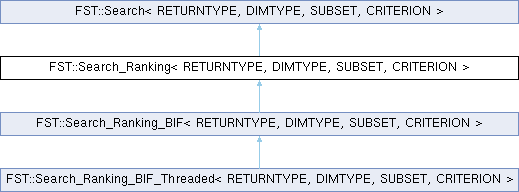
Inheritance diagram for FST::Search_Ranking< RETURNTYPE, DIMTYPE, SUBSET, CRITERION >:
Classes | |
| struct | OneFeature |
| Structure to hold [feature,criterion value] pair while ranking features. More... | |
Public Types | |
| typedef Search< RETURNTYPE, DIMTYPE, SUBSET, CRITERION > | parent |
| the abstract Search interface this class implements | |
| typedef std::shared_ptr< CRITERION > | PCriterion |
| shared pointer to the criterion the search optimizes | |
| typedef std::shared_ptr< SUBSET > | PSubset |
| shared pointer to a feature subset | |
| typedef Candidate_Evaluator< RETURNTYPE, DIMTYPE, SUBSET, CRITERION > | EVALUATORENGINE |
| the injected candidate-evaluation engine interface driving individual-feature evaluation | |
| typedef std::shared_ptr< EVALUATORENGINE > | PEvaluatorEngine |
| Public Types inherited from FST::Search< RETURNTYPE, DIMTYPE, SUBSET, CRITERION > | |
| typedef std::shared_ptr< CRITERION > | PCriterion |
| shared pointer to the criterion the search optimizes | |
| typedef std::shared_ptr< SUBSET > | PSubset |
| shared pointer to a feature subset | |
| typedef std::shared_ptr< Result_Tracker< RETURNTYPE, SUBSET > > | PResultTracker |
| shared pointer to the result tracker enabled via enable_result_tracking() | |
| typedef Search_Observer< RETURNTYPE, SUBSET > | OBSERVER |
| the observer interface type this search reports through (see Search_Observer) | |
| typedef std::shared_ptr< OBSERVER > | PObserver |
| shared pointer to an OBSERVER, as set via set_observer() | |
Public Member Functions | |
| Search_Ranking (PEvaluatorEngine engine=PEvaluatorEngine()) | |
| virtual bool | evaluate_individuals (const DIMTYPE n, const PCriterion crit, std::ostream &os=std::cout)=0 |
ranks all n features individually by crit, filling bifs descending by criterion value (the order within a group of equal values is the concrete method's own convention); called by search() itself, and required before getFirstFeature()/getNextFeature() are used on their own – implemented by the concrete ranking method (e.g. Search_Ranking_BIF) | |
| virtual bool | search (const DIMTYPE target_d, RETURNTYPE &result, const PSubset sub, const PCriterion crit, std::ostream &os=std::cout) override |
ranks the features (evaluate_individuals()) and returns the target_d best-ranked ones, or - for target_d==0 - the best-valued prefix of the ranking; false if the ranking or one of the criterion evaluations failed. target_d must be smaller than the full feature count | |
| bool | getFirstFeature (RETURNTYPE &value, DIMTYPE &feature) const |
iterator over bifs (the ranking built by evaluate_individuals()), highest-ranked feature first; returns false if bifs is empty | |
| bool | getNextFeature (RETURNTYPE &value, DIMTYPE &feature) const |
| continues the getFirstFeature() iteration; returns false once the ranking is exhausted. There is one cursor per object: it is protected against concurrent access in threaded builds, but two interleaved iterations of the same object still consume one another's positions | |
| virtual std::ostream & | print (std::ostream &os) const override |
| writes a human-readable identification of the search and its configuration; base default writes nothing | |
| Public Member Functions inherited from FST::Search< RETURNTYPE, DIMTYPE, SUBSET, CRITERION > | |
| void | enable_result_tracking (PResultTracker tracker) |
| assigns a result tracker to the search process, i.e., enables logging of all evaluated subsets for future reuse (re-evaluation, etc.) | |
| void | disable_result_tracking () |
| detaches any result tracker (result_tracker_active() then returns false) | |
| bool | result_tracker_active () const |
| true if a result tracker was assigned via enable_result_tracking() and not since disabled | |
| void | set_output_detail (OutputDetail detail) |
| sets the amount of information that is logged to output stream throughout the course of search | |
| OutputDetail | get_output_detail () const |
| the currently configured output detail level | |
| bool | output_normal () const |
| true unless output detail is SILENT | |
| bool | output_detailed () const |
| true only at the DETAILED output level | |
| void | set_observer (PObserver observer) |
redirects search progress reporting away from the default syncout text output to observer | |
Protected Types | |
| typedef std::list< OneFeature > | FEATURELIST |
| the individual-feature ranking built by evaluate_individuals(), sorted descending by critval | |
Protected Attributes | |
| PEvaluatorEngine | _engine |
| FEATURELIST | bifs |
| the individual-feature ranking; empty until evaluate_individuals() is called | |
| Protected Attributes inherited from FST::Search< RETURNTYPE, DIMTYPE, SUBSET, CRITERION > | |
| PResultTracker | _tracker |
| the assigned result tracker, or null (see enable_result_tracking()/result_tracker_active()) | |
| OutputDetail | _detail |
| the output detail level set via set_output_detail(); read by output_normal()/output_detailed() | |
| PObserver | _observer |
| the attached progress observer, or null (see set_observer(), report(), report_solution()) | |
Private Attributes | |
| FEATURELIST::const_iterator | get_iter |
| iteration cursor for getFirstFeature()/getNextFeature() (single shared cursor; see get_iter_mutex under FST_THREADED) | |
| std::mutex | get_iter_mutex |
| protects get_iter for thread-safe iteration | |
Additional Inherited Members | |
| Protected Member Functions inherited from FST::Search< RETURNTYPE, DIMTYPE, SUBSET, CRITERION > | |
| void | report (std::ostream &os, const msgbuf &m) const |
| delivers one pre-formatted progress message: to the observer if attached, otherwise as syncout text to os | |
| void | report_solution (std::ostream &os, const RETURNTYPE value, const SUBSET &sub, const msgbuf &m) const |
| like report(), for sites announcing a new (sub-)solution; fires on_solution instead | |
Detailed Description
template<class RETURNTYPE, typename DIMTYPE, class SUBSET, class CRITERION>
class FST::Search_Ranking< RETURNTYPE, DIMTYPE, SUBSET, CRITERION >
class FST::Search_Ranking< RETURNTYPE, DIMTYPE, SUBSET, CRITERION >
Abstract base of the feature-ranking methods: scores features one by one, then turns the ranking into a feature subset.
A concrete ranking method supplies evaluate_individuals() only, which fills the protected bifs list with one (feature, criterion value) record per feature, ordered by descending value; the order of features of equal value is decided by that method. Everything else - the two search() modes, the feature-list bookkeeping and the iteration over the ranking - lives here.
search() has two modes:
- target_d>0: the target_d highest-ranked features form the result, which is evaluated once by the criterion; a result tracker receives that single record.
- target_d==0: every prefix of the ranking is evaluated - the best feature alone, the best two features, and so on - and the best-valued prefix is returned; equal values leave the shorter prefix in place. Here every evaluated prefix is reported to the result tracker.
target_d must be smaller than the full feature count. Note that a ranking of individually evaluated features ignores feature interactions by construction; its subsets are generally weaker than those found by the subset search methods, which is the price for the linear number of criterion evaluations.
Member Typedef Documentation
◆ PEvaluatorEngine
template<class RETURNTYPE, typename DIMTYPE, class SUBSET, class CRITERION>
| typedef std::shared_ptr<EVALUATORENGINE> FST::Search_Ranking< RETURNTYPE, DIMTYPE, SUBSET, CRITERION >::PEvaluatorEngine |
shared pointer to an EVALUATORENGINE, as passed to the constructor
Constructor & Destructor Documentation
◆ Search_Ranking()
template<class RETURNTYPE, typename DIMTYPE, class SUBSET, class CRITERION>
|
inlineexplicit |
- Parameters
-
engine evaluation-strategy engine used to evaluate candidate features; defaults to a fresh Candidate_Evaluator_Sequential (inject Candidate_Evaluator_Threaded for a thread-pooled search() dimensionality-optimization phase)
Member Function Documentation
◆ evaluate_individuals()
template<class RETURNTYPE, typename DIMTYPE, class SUBSET, class CRITERION>
|
pure virtual |
ranks all n features individually by crit, filling bifs descending by criterion value (the order within a group of equal values is the concrete method's own convention); called by search() itself, and required before getFirstFeature()/getNextFeature() are used on their own – implemented by the concrete ranking method (e.g. Search_Ranking_BIF)
Implemented in FST::Search_Ranking_BIF< RETURNTYPE, DIMTYPE, SUBSET, CRITERION >.
◆ print()
template<class RETURNTYPE, typename DIMTYPE, class SUBSET, class CRITERION>
|
inlineoverridevirtual |
writes a human-readable identification of the search and its configuration; base default writes nothing
Reimplemented from FST::Search< RETURNTYPE, DIMTYPE, SUBSET, CRITERION >.
Reimplemented in FST::Search_Ranking_BIF< RETURNTYPE, DIMTYPE, SUBSET, CRITERION >.
◆ search()
template<class RETURNTYPE, typename DIMTYPE, class SUBSET, class CRITERION>
|
overridevirtual |
ranks the features (evaluate_individuals()) and returns the target_d best-ranked ones, or - for target_d==0 - the best-valued prefix of the ranking; false if the ranking or one of the criterion evaluations failed. target_d must be smaller than the full feature count
Implements FST::Search< RETURNTYPE, DIMTYPE, SUBSET, CRITERION >.
Member Data Documentation
◆ _engine
template<class RETURNTYPE, typename DIMTYPE, class SUBSET, class CRITERION>
|
protected |
injected evaluation strategy (sequential-inline or thread-pooled)
The documentation for this class was generated from the following file:
- /Users/psms/dev/devtest1/_src_search/search_ranking.hpp
Generated by
 1.17.0