Loading...
Searching...
No Matches
Public Types |
Public Member Functions |
Protected Types |
Protected Member Functions |
Protected Attributes |
Private Attributes |
List of all members
FST::Search_OS< RETURNTYPE, DIMTYPE, SUBSET, CRITERION, EVALUATOR > Class Template Reference
Implements Oscillating_Search. More...
#include <search_seq_os.hpp>
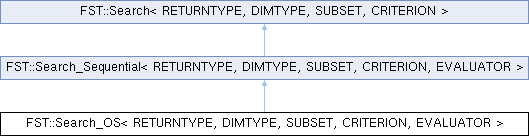
Inheritance diagram for FST::Search_OS< RETURNTYPE, DIMTYPE, SUBSET, CRITERION, EVALUATOR >:
Public Types | |
| typedef Search_Sequential< RETURNTYPE, DIMTYPE, SUBSET, CRITERION, EVALUATOR > | parent |
| base class alias | |
| typedef parent::parent | grandparent |
| the shared Search base (output detail, result tracker) | |
| typedef Search_Ranking_BIF< RETURNTYPE, DIMTYPE, SUBSET, CRITERION > | SearchBIF |
| Best Individual Feature ranking search, used to grow/shrink an initial subset to the requested cardinality (see adjust_initial_subset()). | |
| typedef std::shared_ptr< SearchBIF > | PSearchBIF |
| shared pointer to a SearchBIF instance | |
| typedef std::shared_ptr< EVALUATOR > | PEvaluator |
| shared pointer to the sequential-step evaluator | |
| typedef std::shared_ptr< CRITERION > | PCriterion |
| shared pointer to the criterion the search optimizes | |
| typedef std::shared_ptr< SUBSET > | PSubset |
| shared pointer to a feature subset | |
| Public Types inherited from FST::Search_Sequential< RETURNTYPE, DIMTYPE, SUBSET, CRITERION, EVALUATOR > | |
| typedef Search< RETURNTYPE, DIMTYPE, SUBSET, CRITERION > | parent |
| base class alias | |
| typedef std::shared_ptr< EVALUATOR > | PEvaluator |
| shared pointer to the sequential-step evaluator that implements Step()'s candidate generation and selection | |
| typedef std::shared_ptr< CRITERION > | PCriterion |
| shared pointer to the criterion the search optimizes | |
| typedef std::shared_ptr< SUBSET > | PSubset |
| shared pointer to a feature subset | |
| Public Types inherited from FST::Search< RETURNTYPE, DIMTYPE, SUBSET, CRITERION > | |
| typedef std::shared_ptr< CRITERION > | PCriterion |
| shared pointer to the criterion the search optimizes | |
| typedef std::shared_ptr< SUBSET > | PSubset |
| shared pointer to a feature subset | |
| typedef std::shared_ptr< Result_Tracker< RETURNTYPE, SUBSET > > | PResultTracker |
| shared pointer to the result tracker enabled via enable_result_tracking() | |
| typedef Search_Observer< RETURNTYPE, SUBSET > | OBSERVER |
| the observer interface type this search reports through (see Search_Observer) | |
| typedef std::shared_ptr< OBSERVER > | PObserver |
| shared pointer to an OBSERVER, as set via set_observer() | |
Public Member Functions | |
| Search_OS (const PEvaluator evaluator) | |
evaluator must be non-null; unlike other sequential searches, initial_subset_enabled() is turned ON by construction since OS always starts from (and if needed adjusts) the supplied subset rather than an empty/full one | |
| virtual bool | search (const DIMTYPE target_d, RETURNTYPE &result, const PSubset sub, const PCriterion crit, std::ostream &os=std::cout) override |
| returns found subset + criterion value | |
| void | set_delta (const DIMTYPE delta) |
| oscillating cycle depth | |
| DIMTYPE | get_delta () const |
| the currently configured oscillating cycle depth (see set_delta()) | |
| virtual std::ostream & | print (std::ostream &os) const override |
| writes a human-readable identification of the search and its configuration; base default writes nothing | |
| Public Member Functions inherited from FST::Search_Sequential< RETURNTYPE, DIMTYPE, SUBSET, CRITERION, EVALUATOR > | |
| Search_Sequential (const PEvaluator evaluator) | |
evaluator must be non-null | |
| bool | Step (const bool forward, RETURNTYPE &result, const PSubset sub, const PCriterion crit, std::ostream &os=std::cout) |
Performs one sequential step: adds (forward) or removes (!forward) the best g-tuple of features, g being the generalization level. | |
| void | set_generalization_level (const DIMTYPE g) |
| optional parameter to enlarge the number of considered candidates (g is the number of features added/removed in one Step) | |
| DIMTYPE | get_generalization_level () const |
| the currently configured generalization level (see set_generalization_level()) | |
| void | enable_initial_subset () |
makes search() start from the caller-supplied contents of its sub argument instead of the concrete method's default (empty set for FORWARD, full set for BACKWARD) | |
| void | disable_initial_subset () |
reverts to the default: incoming sub contents are ignored by search() | |
| bool | initial_subset_enabled () const |
| true if enable_initial_subset() was called (and not since disabled by disable_initial_subset()) | |
| Public Member Functions inherited from FST::Search< RETURNTYPE, DIMTYPE, SUBSET, CRITERION > | |
| void | enable_result_tracking (PResultTracker tracker) |
| assigns a result tracker to the search process, i.e., enables logging of all evaluated subsets for future reuse (re-evaluation, etc.) | |
| void | disable_result_tracking () |
| detaches any result tracker (result_tracker_active() then returns false) | |
| bool | result_tracker_active () const |
| true if a result tracker was assigned via enable_result_tracking() and not since disabled | |
| void | set_output_detail (OutputDetail detail) |
| sets the amount of information that is logged to output stream throughout the course of search | |
| OutputDetail | get_output_detail () const |
| the currently configured output detail level | |
| bool | output_normal () const |
| true unless output detail is SILENT | |
| bool | output_detailed () const |
| true only at the DETAILED output level | |
| void | set_observer (PObserver observer) |
redirects search progress reporting away from the default syncout text output to observer | |
Protected Types | |
| enum | SwingPhase { RESTART =0 , DOWN =1 , RETURN_UP =2 , UP =4 , RETURN_DOWN =8 } |
| Oscillating-cycle phase for the OS swing state machine driving search_one()'s inline switch. More... | |
Protected Member Functions | |
| virtual bool | search_one (RETURNTYPE &result, const PSubset sub, const PCriterion crit, std::ostream &os) |
| standard OS initialized by sub, target dimensionality sub->get_d() | |
| virtual bool | adjust_initial_subset (const DIMTYPE target_d, const PSubset sub, const PSearchBIF bif, std::ostream &os) |
Brings sub to exactly target_d features before the oscillation starts: an undersized subset is supplemented with the best-ranked individual features, an oversized one is reduced by removing the worst-ranked ones. A subset that already has target_d features is left untouched. | |
| Protected Member Functions inherited from FST::Search< RETURNTYPE, DIMTYPE, SUBSET, CRITERION > | |
| void | report (std::ostream &os, const msgbuf &m) const |
| delivers one pre-formatted progress message: to the observer if attached, otherwise as syncout text to os | |
| void | report_solution (std::ostream &os, const RETURNTYPE value, const SUBSET &sub, const msgbuf &m) const |
| like report(), for sites announcing a new (sub-)solution; fires on_solution instead | |
Protected Attributes | |
| DIMTYPE | _delta |
| current oscillating cycle depth (max swing extent); see set_delta() | |
| std::unique_ptr< SUBSET > | pivotsub |
| the current pivot: the best-known subset for the ongoing search_one() call, around which DOWN/UP swings are performed | |
| std::unique_ptr< SUBSET > | pivot_top |
| the subset the last UP swing ended on; when the cycle depth grows, the next UP swing resumes from here instead of repeating the steps already taken (valid only while search_one()'s corresponding avail flag is set) | |
| std::unique_ptr< SUBSET > | pivot_bottom |
| the subset the last DOWN swing ended on, used the same way to resume a deeper DOWN swing without repeating steps | |
| std::unique_ptr< SUBSET > | inisub |
| target_d==0 only: an untouched copy of the caller's initial subset, re-used as the starting point for every cardinality tried | |
| std::shared_ptr< SUBSET > | tmpsub |
| target_d==0 only: the working subset one cardinality is searched in, before it is compared with the best result so far | |
| Protected Attributes inherited from FST::Search_Sequential< RETURNTYPE, DIMTYPE, SUBSET, CRITERION, EVALUATOR > | |
| PEvaluator | _evaluator |
| the sequential-step evaluator injected at construction; drives Step()'s candidate generation and best/worst choice | |
| DIMTYPE | _generalization_level |
| number of features added/removed together in one Step() call (see set_generalization_level()) | |
| bool | _initial_subset_enabled |
| by default all concrete search methods ignore the contents of supplied 'PSubset set' and initialize sub according to their definition; if enabled, then (if possible) the search() starts from supplied 'PSubset sub' contents | |
| Protected Attributes inherited from FST::Search< RETURNTYPE, DIMTYPE, SUBSET, CRITERION > | |
| PResultTracker | _tracker |
| the assigned result tracker, or null (see enable_result_tracking()/result_tracker_active()) | |
| OutputDetail | _detail |
| the output detail level set via set_output_detail(); read by output_normal()/output_detailed() | |
| PObserver | _observer |
| the attached progress observer, or null (see set_observer(), report(), report_solution()) | |
Private Attributes | |
| bool | track |
| whether result tracking is enabled, cached per search() call and read throughout search_one() | |
Detailed Description
template<class RETURNTYPE, typename DIMTYPE, class SUBSET, class CRITERION, class EVALUATOR>
class FST::Search_OS< RETURNTYPE, DIMTYPE, SUBSET, CRITERION, EVALUATOR >
class FST::Search_OS< RETURNTYPE, DIMTYPE, SUBSET, CRITERION, EVALUATOR >
Implements Oscillating_Search.
\note By default sub is expected to be initialized prior to search() call, i.e., it should contain a valid initial subset of requested size,
      from which the search will start. If this is not the case and sub does not contain target_d features, sub contents are adjusted
      (sub is enlarged by adding features or shrinked by removing features based on individual
      feature ranking) before the search actually starts. Setting target_d to 0 leads to repeated search() calls for each possible
      subset size, to eventually select among them the solution with highest criterion value.
      To ensure that any initial contents of sub are completely ignored (and initial subset is composed from scratch based purely
      on individual feature ranking), call disable_initial_subset().
- Warning
- Search_OS can not be used with Sequential_Step_Hybrid() parametrized _keep_perc==0 (due to initial filtercrit and crit values mix-up)
Member Enumeration Documentation
◆ SwingPhase
template<class RETURNTYPE, typename DIMTYPE, class SUBSET, class CRITERION, class EVALUATOR>
|
protected |
Oscillating-cycle phase for the OS swing state machine driving search_one()'s inline switch.
RESTART = adopt sub as the new pivot (current best) and begin a DOWN swing; DOWN = shrink the pivot by generalization_level features at a time, down to the current cycle depth; RETURN_UP = restore back up to the pivot's cardinality and check whether the DOWN swing improved on the pivot (if so, RESTART; otherwise try UP); UP = grow the pivot; RETURN_DOWN = restore back down to the pivot's cardinality and check whether the UP swing improved (if so, RESTART; otherwise the cycle depth is increased and DOWN retried). Unlike Search_DOS, improvement is checked only once a swing completes (RETURN_UP/RETURN_DOWN), never after an intermediate Step().
Member Function Documentation
◆ adjust_initial_subset()
template<class RETURNTYPE, typename DIMTYPE, class SUBSET, class CRITERION, class EVALUATOR>
|
protectedvirtual |
Brings sub to exactly target_d features before the oscillation starts: an undersized subset is supplemented with the best-ranked individual features, an oversized one is reduced by removing the worst-ranked ones. A subset that already has target_d features is left untouched.
- Parameters
-
target_d the cardinality to reach; must be >0 and at most sub->get_n() sub the subset to adjust in place bif a ranking search whose evaluate_individuals() has already been run on the same criterion and feature space; it supplies the individual-feature order os messages are written here at NORMAL output detail or above
- Returns
- false if
bifyields no ranking, or if the adjustment could not reachtarget_d
◆ print()
template<class RETURNTYPE, typename DIMTYPE, class SUBSET, class CRITERION, class EVALUATOR>
|
overridevirtual |
writes a human-readable identification of the search and its configuration; base default writes nothing
Reimplemented from FST::Search< RETURNTYPE, DIMTYPE, SUBSET, CRITERION >.
◆ search()
template<class RETURNTYPE, typename DIMTYPE, class SUBSET, class CRITERION, class EVALUATOR>
|
overridevirtual |
returns found subset + criterion value
Implements FST::Search_Sequential< RETURNTYPE, DIMTYPE, SUBSET, CRITERION, EVALUATOR >.
◆ search_one()
template<class RETURNTYPE, typename DIMTYPE, class SUBSET, class CRITERION, class EVALUATOR>
|
protectedvirtual |
standard OS initialized by sub, target dimensionality sub->get_d()
returns found subset + criterion value
The documentation for this class was generated from the following file:
- /Users/psms/dev/devtest1/_src_search/search_seq_os.hpp
Generated by
 1.17.0