Loading...
Searching...
No Matches
FST::Search_Exhaustive< RETURNTYPE, DIMTYPE, SUBSET, CRITERION > Class Template Reference
Implements exhaustive (optimal) search yielding optimal feature subset with respect to chosen criterion. More...
#include <search_exhaustive.hpp>
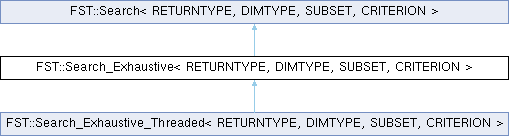
Inheritance diagram for FST::Search_Exhaustive< RETURNTYPE, DIMTYPE, SUBSET, CRITERION >:
Public Types | |
| typedef Search< RETURNTYPE, DIMTYPE, SUBSET, CRITERION > | parent |
| base class: the generic search interface | |
| typedef std::shared_ptr< CRITERION > | PCriterion |
| shared pointer to the criterion being optimized | |
| typedef std::shared_ptr< SUBSET > | PSubset |
| shared pointer to a feature subset | |
| typedef Candidate_Evaluator< RETURNTYPE, DIMTYPE, SUBSET, CRITERION > | EVALUATORENGINE |
| the candidate-evaluation engine type (sequential or threaded) | |
| typedef std::shared_ptr< EVALUATORENGINE > | PEvaluatorEngine |
| shared pointer to the evaluation engine | |
| Public Types inherited from FST::Search< RETURNTYPE, DIMTYPE, SUBSET, CRITERION > | |
| typedef std::shared_ptr< CRITERION > | PCriterion |
| shared pointer to the criterion the search optimizes | |
| typedef std::shared_ptr< SUBSET > | PSubset |
| shared pointer to a feature subset | |
| typedef std::shared_ptr< Result_Tracker< RETURNTYPE, SUBSET > > | PResultTracker |
| shared pointer to the result tracker enabled via enable_result_tracking() | |
| typedef Search_Observer< RETURNTYPE, SUBSET > | OBSERVER |
| the observer interface type this search reports through (see Search_Observer) | |
| typedef std::shared_ptr< OBSERVER > | PObserver |
| shared pointer to an OBSERVER, as set via set_observer() | |
Public Member Functions | |
| Search_Exhaustive (PEvaluatorEngine engine=PEvaluatorEngine()) | |
Constructs the search with the given candidate-evaluation engine; a default-constructed engine falls back to Candidate_Evaluator_Sequential (in-line, unthreaded evaluation). | |
| virtual bool | search (const DIMTYPE target_d, RETURNTYPE &result, const PSubset sub, const PCriterion crit, std::ostream &os=std::cout) override |
| evaluates every subset of the requested size (every subset of any size from 1 to n if target_d==0) and returns the best one + its criterion value; false if no candidate could be generated (n==0, or the subset object refused to enumerate) or a criterion evaluation failed | |
| virtual std::ostream & | print (std::ostream &os) const override |
| writes a human-readable identification of the search and its configuration; base default writes nothing | |
| Public Member Functions inherited from FST::Search< RETURNTYPE, DIMTYPE, SUBSET, CRITERION > | |
| void | enable_result_tracking (PResultTracker tracker) |
| assigns a result tracker to the search process, i.e., enables logging of all evaluated subsets for future reuse (re-evaluation, etc.) | |
| void | disable_result_tracking () |
| detaches any result tracker (result_tracker_active() then returns false) | |
| bool | result_tracker_active () const |
| true if a result tracker was assigned via enable_result_tracking() and not since disabled | |
| void | set_output_detail (OutputDetail detail) |
| sets the amount of information that is logged to output stream throughout the course of search | |
| OutputDetail | get_output_detail () const |
| the currently configured output detail level | |
| bool | output_normal () const |
| true unless output detail is SILENT | |
| bool | output_detailed () const |
| true only at the DETAILED output level | |
| void | set_observer (PObserver observer) |
redirects search progress reporting away from the default syncout text output to observer | |
Protected Attributes | |
| PEvaluatorEngine | _engine |
| the injected candidate-evaluation engine (defaults to sequential) | |
| Protected Attributes inherited from FST::Search< RETURNTYPE, DIMTYPE, SUBSET, CRITERION > | |
| PResultTracker | _tracker |
| the assigned result tracker, or null (see enable_result_tracking()/result_tracker_active()) | |
| OutputDetail | _detail |
| the output detail level set via set_output_detail(); read by output_normal()/output_detailed() | |
| PObserver | _observer |
| the attached progress observer, or null (see set_observer(), report(), report_solution()) | |
Additional Inherited Members | |
| Protected Member Functions inherited from FST::Search< RETURNTYPE, DIMTYPE, SUBSET, CRITERION > | |
| void | report (std::ostream &os, const msgbuf &m) const |
| delivers one pre-formatted progress message: to the observer if attached, otherwise as syncout text to os | |
| void | report_solution (std::ostream &os, const RETURNTYPE value, const SUBSET &sub, const msgbuf &m) const |
| like report(), for sites announcing a new (sub-)solution; fires on_solution instead | |
Detailed Description
template<class RETURNTYPE, typename DIMTYPE, class SUBSET, class CRITERION>
class FST::Search_Exhaustive< RETURNTYPE, DIMTYPE, SUBSET, CRITERION >
class FST::Search_Exhaustive< RETURNTYPE, DIMTYPE, SUBSET, CRITERION >
Implements exhaustive (optimal) search yielding optimal feature subset with respect to chosen criterion.
This single class serves both the sequential and the threaded execution model: the evaluation strategy (a Candidate_Evaluator implementation) is injected through the constructor and defaults to sequential in-line evaluation; construct with a Candidate_Evaluator_Threaded to evaluate candidates in a thread pool. Results are the same either way - for a fixed seed the search yields the same subset at any thread count. Candidates are streamed to the evaluation engine - they are never materialized as a whole (their count grows combinatorially with n).
- Note
- Due to possibly high number of subsets to be tested expect excessive computational time. In case of result tracking the excessive number of possible combinations may consume unacceptable amount of memory - to prevent this it is highly recommended to set up result tracker storage limit.
Constructor & Destructor Documentation
◆ Search_Exhaustive()
template<class RETURNTYPE, typename DIMTYPE, class SUBSET, class CRITERION>
|
inlineexplicit |
Constructs the search with the given candidate-evaluation engine; a default-constructed engine falls back to Candidate_Evaluator_Sequential (in-line, unthreaded evaluation).
- Parameters
-
engine the evaluation strategy to use; pass a Candidate_Evaluator_Threaded to evaluate candidates in a thread pool
Member Function Documentation
◆ print()
template<class RETURNTYPE, typename DIMTYPE, class SUBSET, class CRITERION>
|
inlineoverridevirtual |
writes a human-readable identification of the search and its configuration; base default writes nothing
Reimplemented from FST::Search< RETURNTYPE, DIMTYPE, SUBSET, CRITERION >.
◆ search()
template<class RETURNTYPE, typename DIMTYPE, class SUBSET, class CRITERION>
|
overridevirtual |
evaluates every subset of the requested size (every subset of any size from 1 to n if target_d==0) and returns the best one + its criterion value; false if no candidate could be generated (n==0, or the subset object refused to enumerate) or a criterion evaluation failed
Implements FST::Search< RETURNTYPE, DIMTYPE, SUBSET, CRITERION >.
The documentation for this class was generated from the following file:
- /Users/psms/dev/devtest1/_src_search/search_exhaustive.hpp
Generated by
 1.17.0