Loading...
Searching...
No Matches
Classes |
Public Types |
Public Member Functions |
Protected Types |
Static Protected Member Functions |
Protected Attributes |
List of all members
FST::Result_Tracker_Feature_Stats< RETURNTYPE, IDXTYPE, DIMTYPE, SUBSET > Class Template Reference
Collects evaluated subsets to eventually provide Dependency-Aware Feature Ranking coefficients. More...
#include <result_tracker_feature_stats.hpp>
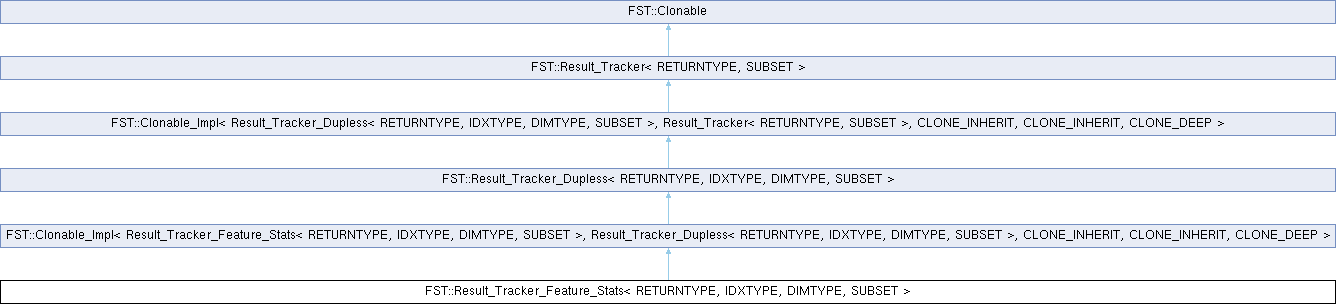
Inheritance diagram for FST::Result_Tracker_Feature_Stats< RETURNTYPE, IDXTYPE, DIMTYPE, SUBSET >:
Classes | |
| struct | FeatureStat |
| Structure to gather feature occurrence statistics over probe subset evaluations. More... | |
| struct | SubSizeStat |
| Structure to gather probe subset cardinality statistics. More... | |
| struct | PairStat |
| Structure to hold pairwise feature statistics (2x2 presence-cell contrasts over probe subset evaluations). More... | |
Public Types | |
| typedef Result_Tracker_Dupless< RETURNTYPE, IDXTYPE, DIMTYPE, SUBSET > | parent |
| the base tracker: dupless probe storage sorted descending by criterion value; this class adds DAF post-processing over it | |
| typedef Clonable_Impl< Result_Tracker_Feature_Stats, parent, CLONE_INHERIT, CLONE_INHERIT, CLONE_DEEP > | parent_impl |
| implements stateless_clone(); clone()/sharing_clone() throw in Result_Tracker | |
| typedef parent::ResultRec | ResultRec |
| [subset,criterion value] result record, see Result_Tracker::ResultRec | |
| typedef ResultRec * | PResultRec |
| raw pointer to a ResultRec, as used by the inherited get_first()/get_next() iteration | |
| typedef std::shared_ptr< SUBSET > | PSubset |
| Public Types inherited from FST::Result_Tracker_Dupless< RETURNTYPE, IDXTYPE, DIMTYPE, SUBSET > | |
| typedef Result_Tracker< RETURNTYPE, SUBSET > | parent |
| the abstract Result_Tracker interface this class implements | |
| typedef Clonable_Impl< Result_Tracker_Dupless, parent, CLONE_INHERIT, CLONE_INHERIT, CLONE_DEEP > | parent_impl |
| implements stateless_clone() via the copy-constructor (CLONE_DEEP); clone()/sharing_clone() are inherited from Result_Tracker, which throws for both | |
| typedef parent::ResultRec | ResultRec |
| see Result_Tracker::ResultRec | |
| typedef parent::PResultRec | PResultRec |
| see Result_Tracker::PResultRec | |
| typedef std::shared_ptr< SUBSET > | PSubset |
| typedef std::list< ResultRec >::const_iterator | CONSTRESULTSITER |
| read-only iterator over results, for use by subclasses/friends inspecting the collected results | |
| typedef std::list< ResultRec >::iterator | RESULTSITER |
| mutable iterator over results, as returned by begin()/end() | |
| Public Types inherited from FST::Result_Tracker< RETURNTYPE, SUBSET > | |
| typedef std::shared_ptr< SUBSET > | PSubset |
| shared pointer to a tracked feature subset | |
| typedef ResultRec * | PResultRec |
| raw pointer to a ResultRec, as used by get_first()/get_next() iteration | |
Public Member Functions | |
| Result_Tracker_Feature_Stats (const IDXTYPE capacity_limit=0) | |
| Result_Tracker_Feature_Stats (const Result_Tracker_Feature_Stats &rtfs) | |
| the stateless_clone() copy: replicates configuration (capacity limit, margin) via the parent copy-constructor but starts with an empty probe list and no computed statistics – compute_stats()/compute_pair_stats() must be rerun on the clone | |
| bool | compute_stats (std::ostream &os=std::cout) |
| Aggregates DAF ranking statistics (DAF0/DAF1/DAF2) from all probe subsets recorded so far. | |
| bool | print_stats (std::ostream &os=std::cout) |
| bool | getFirstDAF (RETURNTYPE &value, DIMTYPE &feature, const unsigned int DAFidx=0) const |
| Starts an iteration (descending by value) over the feature ordering built by compute_stats() for the given DAF variant. | |
| bool | getNextDAF (RETURNTYPE &value, DIMTYPE &feature, const unsigned int DAFidx=0) const |
| bool | compute_pair_stats (const DIMTYPE top_k, std::ostream &os=std::cout) |
Computes pairwise (group) DAF statistics: 2x2 presence-cell contrasts over all pairs of the top top_k DAF0-ranked features. | |
| bool | print_pair_stats (std::ostream &os=std::cout, const std::size_t top_pairs=0) |
| bool | getFirstPairDAF (RETURNTYPE &daf0, RETURNTYPE &daf1, bool &daf1_valid, RETURNTYPE &synergy, DIMTYPE &f1, DIMTYPE &f2) const |
| Starts an iteration (decreasing pair-DAF0) over the pairwise statistics built by compute_pair_stats(). | |
| bool | getNextPairDAF (RETURNTYPE &daf0, RETURNTYPE &daf1, bool &daf1_valid, RETURNTYPE &synergy, DIMTYPE &f1, DIMTYPE &f2) const |
| virtual std::ostream & | print (std::ostream &os) const override |
| writes a human-readable identification of the object; base default writes nothing | |
| Public Member Functions inherited from FST::Clonable_Impl< Result_Tracker_Feature_Stats< RETURNTYPE, IDXTYPE, DIMTYPE, SUBSET >, Result_Tracker_Dupless< RETURNTYPE, IDXTYPE, DIMTYPE, SUBSET >, CLONE_INHERIT, CLONE_INHERIT, CLONE_DEEP > | |
| Result_Tracker_Dupless< RETURNTYPE, IDXTYPE, DIMTYPE, SUBSET > * | clone () const override |
| dispatches to the DEEP_KIND mechanism (default CLONE_DEEP: Derived's copy-constructor) | |
| Result_Tracker_Dupless< RETURNTYPE, IDXTYPE, DIMTYPE, SUBSET > * | sharing_clone () const override |
| dispatches to the SHARING_KIND mechanism (default CLONE_INHERIT: defers to Base, which throws by family convention) | |
| Result_Tracker_Dupless< RETURNTYPE, IDXTYPE, DIMTYPE, SUBSET > * | stateless_clone () const override |
| dispatches to the STATELESS_KIND mechanism (default CLONE_INHERIT: defers to Base, which throws by family convention) | |
| Public Member Functions inherited from FST::Result_Tracker_Dupless< RETURNTYPE, IDXTYPE, DIMTYPE, SUBSET > | |
| Result_Tracker_Dupless (const IDXTYPE capacity_limit=0) | |
| Result_Tracker_Dupless (const Result_Tracker_Dupless &rtd) | |
copies the configuration (margin, cardinality restriction, capacity limit) only; the results list is NOT copied (starts empty) – this constructor backs stateless_clone() (CLONE_DEEP), which by contract does not replicate exact object state | |
| virtual bool | add (const RETURNTYPE value, const PSubset sub) override |
Offers one (value, subset) result for inclusion; sub is copied, the caller keeps ownership of its own object. | |
| virtual void | clear () override |
| discards all recorded results | |
| virtual std::size_t | size () const override |
| number of results currently held (std::size_t rather than 'long': on LLP64 platforms 'long' is 32 bits and would narrow the container's own size type) | |
| virtual std::size_t | size (const RETURNTYPE margin) const |
number of currently held results whose value is within margin of the best (first, highest-value) held result | |
| virtual bool | get_first (PResultRec &r) override |
| starts iteration at the best held result; false if nothing is held. The returned pointer refers into this tracker's own storage and is invalidated by add(), join() and clear() | |
| virtual bool | get_next (PResultRec &r) override |
| hands out the next result in descending-value order; false when the iteration is exhausted. There is one shared cursor per tracker, so nested or concurrent iterations of the same tracker interfere | |
| virtual void | join (Result_Tracker< RETURNTYPE, SUBSET > &src) override |
merges the results held by src into this tracker, keeping the ordering and skipping duplicates exactly as add() does, then re-applies the capacity limit and the margin to the merged list. Consumes src's iteration cursor; src itself is left unchanged | |
| void | set_inclusion_margin (const RETURNTYPE margin=0) |
| restrict adding to only subsets with criterion value within given distance (margin) from best known | |
| void | set_inclusion_cardinality_restriction (const DIMTYPE d) |
| for d>0 restricts adding only to subsets of size d, for d=0 subset size restriction is removed | |
| RESULTSITER | begin () |
| iterator to the best (first) held result | |
| RESULTSITER | end () |
| iterator past the last held result | |
| Public Member Functions inherited from FST::Result_Tracker< RETURNTYPE, SUBSET > | |
| Result_Tracker (const Result_Tracker &rt) | |
| copies the output-detail setting only – concrete trackers copy their own collected results separately | |
| Result_Tracker * | clone () const override |
| Result_Tracker * | sharing_clone () const override |
| void | set_output_detail (OutputDetail detail) |
| sets the amount of information that is logged to output stream throughout the course of search | |
| OutputDetail | get_output_detail () const |
| the currently configured output detail level | |
| bool | output_normal () const |
| true unless output detail is SILENT | |
| bool | output_detailed () const |
| true only at the DETAILED output level | |
| Public Member Functions inherited from FST::Clonable | |
| bool | is_clone () const |
| bool | is_sharing () const |
| true if this instance is a sharing_clone() result (referencing, not owning, the source's structures) | |
| bool | is_sharing_clone () const |
| true if this instance is BOTH a clone and sharing – i.e. specifically a sharing_clone() result, not a clone()/stateless_clone() one | |
Protected Types | |
| typedef std::vector< DIMTYPE > | ORDERTYPE |
| feature-index ordering vector, as built per DAF variant by compute_stats() | |
Static Protected Member Functions | |
| static std::size_t | pair_index (const std::size_t a, const std::size_t b, const std::size_t k) |
| Upper-triangle linearization of pair (a,b), a<b<k, into a flat index over PairStat storage (k = the top-k feature-set size). | |
Protected Attributes | |
| DIMTYPE | _n |
| std::vector< FeatureStat > | _stats |
| one entry per feature (index 0.._n-1), aggregated over all recorded probes; filled by compute_stats() | |
| std::vector< SubSizeStat > | _dstat |
| one entry per subset size 1.._n (index 0 unused); filled by compute_stats() | |
| ORDERTYPE | _order [3] |
| per DAF variant (0=DAF0, 1=DAF1, 2=DAF2): feature indices with a valid DAF value, sorted descending by that value; built by compute_stats() | |
| DIMTYPE | _itersize [3] |
| per DAF variant: getFirstDAF()/getNextDAF() cursor position (index into _order[DAFidx]); 0 = iteration not started | |
| std::mutex | _itersize_mutex |
| serializes access to the iteration cursors _itersize AND _pair_itersize across concurrent getFirst/getNext calls (threaded builds only) | |
| std::vector< PairStat > | _pair_stats |
| upper-triangle linearization (via pair_index()) over the top-k feature set; filled by compute_pair_stats() | |
| std::vector< DIMTYPE > | _pair_features |
| the top-k DAF0-ranked (global) feature indices the pairs are drawn from | |
| std::vector< std::size_t > | _pair_order |
| indices into _pair_stats, valid pairs only, sorted decreasing pair-DAF0 | |
| std::size_t | _pair_itersize |
| Protected Attributes inherited from FST::Result_Tracker_Dupless< RETURNTYPE, IDXTYPE, DIMTYPE, SUBSET > | |
| std::list< ResultRec > | results |
| held results, sorted descending by value (ties broken toward the smaller subset); see add() for the exact insertion/dedup/trim rule | |
| RETURNTYPE | _margin |
| set via set_inclusion_margin(); 0 = no margin restriction | |
| DIMTYPE | _restrict_to_d |
| set via set_inclusion_cardinality_restriction(); 0 = no subset-size restriction | |
| const IDXTYPE | _capacity_limit |
| set by the constructor; 0 = unlimited | |
| Protected Attributes inherited from FST::Result_Tracker< RETURNTYPE, SUBSET > | |
| OutputDetail | _detail |
| the output detail level set via set_output_detail(); read by output_normal()/output_detailed() | |
Additional Inherited Members | |
| Protected Member Functions inherited from FST::Clonable | |
| void | set_cloned (const bool cloned=true) |
| marks/unmarks this instance as a clone; call from clone()/stateless_clone() overrides (Clonable_Impl does this automatically) | |
| void | set_sharing (const bool sharing=true) |
| marks/unmarks this instance as sharing (see is_sharing()) | |
| void | set_sharing_cloned (const bool cloned=true, const bool sharing=true) |
| sets both flags at once; call from sharing_clone() overrides (Clonable_Impl does this automatically) | |
Detailed Description
template<class RETURNTYPE, typename IDXTYPE, typename DIMTYPE, class SUBSET>
class FST::Result_Tracker_Feature_Stats< RETURNTYPE, IDXTYPE, DIMTYPE, SUBSET >
class FST::Result_Tracker_Feature_Stats< RETURNTYPE, IDXTYPE, DIMTYPE, SUBSET >
Collects evaluated subsets to eventually provide Dependency-Aware Feature Ranking coefficients.
Dependency-Aware Feature ranking (DAF) is a new type of ranking method especially suitable for very-high-dimensional feature selection. Unlike standard individual feature ranking, the DAF ranking reflects "average feature quality in context" and as such is capable of providing significantly better results than BIF (provided the data actually do contain mutually dependent features). The method has been described in combination with Monte Carlo based feature selection permitting Wrapper Criteria even in very-high-dimensional setting. The tracker is not a search of its own: attach it to any search that generates many probe subsets (Monte Carlo search is the usual choice), let the search run, then call compute_stats() and read the ranking off getFirstDAF()/getNextDAF(). For ready-to-run examples see the demo34 and demo35t protocols (demos/demo34.cfg, demos/demo35t.cfg). For more detailed information see UTIA Technical Report No. 2295.
Member Typedef Documentation
◆ PSubset
template<class RETURNTYPE, typename IDXTYPE, typename DIMTYPE, class SUBSET>
| typedef std::shared_ptr<SUBSET> FST::Result_Tracker_Feature_Stats< RETURNTYPE, IDXTYPE, DIMTYPE, SUBSET >::PSubset |
shared pointer to a tracked feature subset
Constructor & Destructor Documentation
◆ Result_Tracker_Feature_Stats()
template<class RETURNTYPE, typename IDXTYPE, typename DIMTYPE, class SUBSET>
|
inline |
- Parameters
-
capacity_limit forwarded to Result_Tracker_Dupless; 0 (the fst4 CLI default for this tracker) means unlimited probe storage
Member Function Documentation
◆ compute_pair_stats()
template<class RETURNTYPE, typename IDXTYPE, typename DIMTYPE, class SUBSET>
| bool FST::Result_Tracker_Feature_Stats< RETURNTYPE, IDXTYPE, DIMTYPE, SUBSET >::compute_pair_stats | ( | const DIMTYPE | top_k, |
| std::ostream & | os = std::cout ) |
Computes pairwise (group) DAF statistics: 2x2 presence-cell contrasts over all pairs of the top top_k DAF0-ranked features.
A post-processing pass purely over the probes already recorded by compute_stats() (search logic and the per-feature DAF0/DAF1/DAF2 statistics above are unaffected). It exposes the statistics only - no ranking heuristic is baked in. For each pair (f1,f2) drawn from the top-k DAF0-ranked feature set, splits the recorded probes into the four 2x2 presence cells (both selected, both absent, f1-only, f2-only); only the both-present cell is accumulated directly per probe, the other three are derived from it plus the per-feature and grand totals by inclusion-exclusion. Reported per pair: pair-DAF0 = mean(both present) - mean(both absent); pair-DAF1 = pair-DAF0 normalized by the frequency-weighted stdevs of those two cells (the DAF1 analogue); synergy = mean_both + mean_neither - mean_f1only - mean_f2only (the 2x2 interaction contrast). A pair is valid only if all four presence cells are non-empty; among valid pairs, pair-DAF1 is additionally marked invalid if its normalization denominator is zero. Builds the getFirstPairDAF()/getNextPairDAF() ordering (valid pairs only, decreasing pair-DAF0).
- Parameters
-
top_k requires a prior compute_stats() call: the top top_kDAF0-ranked features define the pair set; must be >=2os progress/warning messages are written here at NORMAL output detail or above
- Returns
- false if compute_stats() has not been run, if fewer than 2 features have a valid DAF0, if
top_k<2, or if no pair turns out valid
◆ compute_stats()
template<class RETURNTYPE, typename IDXTYPE, typename DIMTYPE, class SUBSET>
| bool FST::Result_Tracker_Feature_Stats< RETURNTYPE, IDXTYPE, DIMTYPE, SUBSET >::compute_stats | ( | std::ostream & | os = std::cout | ) |
Aggregates DAF ranking statistics (DAF0/DAF1/DAF2) from all probe subsets recorded so far.
For each feature, splits the recorded (subset,value) probes into those where the feature is selected ("is") and not selected ("isnot"), and computes per-partition mean/stdev of the criterion value plus DAF0 = mean_is-mean_isnot and DAF1 = DAF0 normalized by the frequency-weighted partition stdevs; DAF2 is a further variant, normalized per probe by the stdev of same-cardinality probes (the "DAF3" measure of UTIA Technical Report No. 2295) – unlike DAF0/DAF1, DAF2 is marked valid for every feature unconditionally, even when insufficient same-cardinality probes force its value to 0. Also aggregates per-cardinality (per subset size) mean/stdev of the criterion value. Builds the getFirstDAF()/getNextDAF() ordering for all three variants (descending by DAF value, features without a valid value excluded). Must be called (and re-called after adding more probes) before print_stats(), getFirstDAF()/getNextDAF() or compute_pair_stats() return meaningful results.
- Parameters
-
os progress/warning messages are written here at NORMAL output detail or above (see Result_Tracker::set_output_detail()); unused at SILENT
- Returns
- false if no probes have been recorded yet
◆ getFirstDAF()
template<class RETURNTYPE, typename IDXTYPE, typename DIMTYPE, class SUBSET>
| bool FST::Result_Tracker_Feature_Stats< RETURNTYPE, IDXTYPE, DIMTYPE, SUBSET >::getFirstDAF | ( | RETURNTYPE & | value, |
| DIMTYPE & | feature, | ||
| const unsigned int | DAFidx = 0 ) const |
Starts an iteration (descending by value) over the feature ordering built by compute_stats() for the given DAF variant.
- Parameters
-
value set to the feature's DAF value on success feature set to the (global) feature index on success DAFidx selects the DAF variant: 0 (DAF0), 1 (DAF1) or 2 (DAF2); the fst4 CLI's --daf-rank only exposes 0 and 1, DAF2 is library-only
- Returns
- false if compute_stats() has not run or no feature has a valid value for this variant
◆ getFirstPairDAF()
template<class RETURNTYPE, typename IDXTYPE, typename DIMTYPE, class SUBSET>
| bool FST::Result_Tracker_Feature_Stats< RETURNTYPE, IDXTYPE, DIMTYPE, SUBSET >::getFirstPairDAF | ( | RETURNTYPE & | daf0, |
| RETURNTYPE & | daf1, | ||
| bool & | daf1_valid, | ||
| RETURNTYPE & | synergy, | ||
| DIMTYPE & | f1, | ||
| DIMTYPE & | f2 ) const |
Starts an iteration (decreasing pair-DAF0) over the pairwise statistics built by compute_pair_stats().
- Parameters
-
daf0 set to mean(both present) - mean(both absent) for the pair daf1 set to the DAF1-analogue normalization of daf0; 0 ifdaf1_validis falsedaf1_valid set to false when the pair's normalization denominator is zero ( daf1then holds 0)synergy set to the 2x2 interaction contrast (mean_both + mean_neither - mean_f1only - mean_f2only) f1 set to the (global) index of the pair's first feature f2 set to the (global) index of the pair's second feature
- Returns
- false if compute_pair_stats() has not run or found no valid pair
◆ getNextDAF()
template<class RETURNTYPE, typename IDXTYPE, typename DIMTYPE, class SUBSET>
| bool FST::Result_Tracker_Feature_Stats< RETURNTYPE, IDXTYPE, DIMTYPE, SUBSET >::getNextDAF | ( | RETURNTYPE & | value, |
| DIMTYPE & | feature, | ||
| const unsigned int | DAFidx = 0 ) const |
Continues the getFirstDAF() iteration for the same DAFidx.
- Returns
- false once the ordering is exhausted (or if getFirstDAF() was never called for this DAFidx)
◆ getNextPairDAF()
template<class RETURNTYPE, typename IDXTYPE, typename DIMTYPE, class SUBSET>
| bool FST::Result_Tracker_Feature_Stats< RETURNTYPE, IDXTYPE, DIMTYPE, SUBSET >::getNextPairDAF | ( | RETURNTYPE & | daf0, |
| RETURNTYPE & | daf1, | ||
| bool & | daf1_valid, | ||
| RETURNTYPE & | synergy, | ||
| DIMTYPE & | f1, | ||
| DIMTYPE & | f2 ) const |
Continues the getFirstPairDAF() iteration.
- Returns
- false once the ordering is exhausted (or if getFirstPairDAF() was never called)
◆ print()
template<class RETURNTYPE, typename IDXTYPE, typename DIMTYPE, class SUBSET>
|
inlineoverridevirtual |
writes a human-readable identification of the object; base default writes nothing
Reimplemented from FST::Result_Tracker_Dupless< RETURNTYPE, IDXTYPE, DIMTYPE, SUBSET >.
◆ print_pair_stats()
template<class RETURNTYPE, typename IDXTYPE, typename DIMTYPE, class SUBSET>
| bool FST::Result_Tracker_Feature_Stats< RETURNTYPE, IDXTYPE, DIMTYPE, SUBSET >::print_pair_stats | ( | std::ostream & | os = std::cout, |
| const std::size_t | top_pairs = 0 ) |
Prints the pairwise statistics computed by compute_pair_stats() to os, best pair-DAF0 first.
- Parameters
-
os the output stream to print to top_pairs how many top pairs to print; 0 (the default) prints all valid pairs
- Returns
- false if compute_pair_stats() has not run (or found no valid pair)
◆ print_stats()
template<class RETURNTYPE, typename IDXTYPE, typename DIMTYPE, class SUBSET>
| bool FST::Result_Tracker_Feature_Stats< RETURNTYPE, IDXTYPE, DIMTYPE, SUBSET >::print_stats | ( | std::ostream & | os = std::cout | ) |
Prints the per-cardinality and per-feature statistics computed by compute_stats() to os.
- Returns
- false if compute_stats() has not been run yet (nothing to print)
Member Data Documentation
◆ _n
template<class RETURNTYPE, typename IDXTYPE, typename DIMTYPE, class SUBSET>
|
protected |
total number of features in the tracked dataset (from the first recorded probe's Subset::get_n(), assumed the same for all probes); also the length of _stats and one less than the length of _dstat
◆ _pair_itersize
template<class RETURNTYPE, typename IDXTYPE, typename DIMTYPE, class SUBSET>
|
mutableprotected |
getFirstPairDAF()/getNextPairDAF() cursor position (index into _pair_order); 0 = iteration not started
The documentation for this class was generated from the following file:
- /Users/psms/dev/devtest1/_src_search/result_tracker_feature_stats.hpp
Generated by
 1.17.0