Loading...
Searching...
No Matches
Public Types |
Public Member Functions |
Protected Member Functions |
Protected Attributes |
List of all members
FST::Data_Accessor_Universe< DATATYPE, IDXTYPE, INTERVALCONTAINER > Class Template Reference
Data-free accessor over an abstract feature universe of N features (the fst4 CLI's --features N entry; the companion of criterion_extern_value.hpp in its data-free mode). More...
#include <data_accessor_universe.hpp>
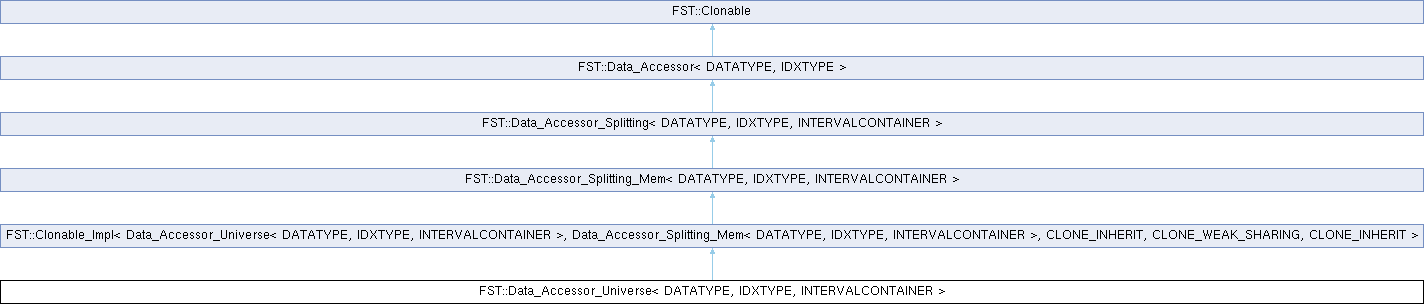
Inheritance diagram for FST::Data_Accessor_Universe< DATATYPE, IDXTYPE, INTERVALCONTAINER >:
Public Types | |
| typedef Data_Accessor_Splitting_Mem< DATATYPE, IDXTYPE, INTERVALCONTAINER > | DASM |
| the immediate base class, aliased for brevity | |
| typedef DASM::DAS | DAS |
| inherited: the Data_Accessor_Splitting base, used for its CLASSSIZES/enum_split/getSplittingDepth() machinery | |
| typedef Clonable_Impl< Data_Accessor_Universe, DASM, CLONE_INHERIT, CLONE_WEAK_SHARING, CLONE_INHERIT > | parent_impl |
| typedef std::shared_ptr< Data_Scaler< DATATYPE > > | PScaler |
| accepted for constructor-signature compatibility only; this accessor is data-free and never uses a scaler | |
| typedef DASM::PSplitters | PSplitters |
| Public Types inherited from FST::Data_Accessor_Splitting_Mem< DATATYPE, IDXTYPE, INTERVALCONTAINER > | |
| typedef Data_Accessor_Splitting< DATATYPE, IDXTYPE, INTERVALCONTAINER > | DAS |
| the immediate base class, aliased for brevity in derived classes | |
| typedef std::shared_ptr< Data_Scaler< DATATYPE > > | PScaler |
| shared pointer to the scaler applied to loaded data | |
| typedef DAS::PPattern | PPattern |
| inherited from Data_Accessor: raw pointer to one read-only feature vector | |
| typedef DAS::PSplitters | PSplitters |
| Public Types inherited from FST::Data_Accessor_Splitting< DATATYPE, IDXTYPE, INTERVALCONTAINER > | |
| typedef std::shared_ptr< Data_Splitter< INTERVALCONTAINER, IDXTYPE > > | PSplitter |
| shared pointer to one Data_Splitter (one nested splitting level) | |
| typedef std::shared_ptr< std::vector< PSplitter > > | PSplitters |
| shared pointer to the ordered list of splitters, one per nested splitting depth (depth 0 = outermost) | |
| typedef const DATATYPE * | PPattern |
| Public Types inherited from FST::Data_Accessor< DATATYPE, IDXTYPE > | |
| typedef const DATATYPE * | PPattern |
| one data sample: a raw pointer to its (read-only) feature vector, getNoOfFeatures() entries long | |
Public Member Functions | |
| Data_Accessor_Universe (const unsigned int n_features, const PSplitters _dsp, const PScaler _dsc) | |
Constructs the accessor over an abstract universe of n_features features; _dsp and _dsc are accepted for structural compatibility with the other Data_Accessor_Splitting_Mem descendants but are never exercised. | |
| virtual void | initialize () override |
| no file to read: announces the universe and sets up the degenerate shape (N features, 0 classes) Writes a one-line summary of the universe on standard output through syncout::print(), and throws fst_error if the universe is empty or if it is called on a sharing clone. | |
| virtual bool | getFirstSplit () override |
| enters the single split; always true | |
| virtual bool | getNextSplit () override |
| always false: the single split is the only one | |
| virtual unsigned int | getNoOfSplits () const override |
| always 1 | |
| virtual std::ostream & | print (std::ostream &os) const override |
writes the splitter stack's print() output (or "Data_Accessor_Splitting()" if the stack is empty) to os | |
| Public Member Functions inherited from FST::Clonable_Impl< Data_Accessor_Universe< DATATYPE, IDXTYPE, INTERVALCONTAINER >, Data_Accessor_Splitting_Mem< DATATYPE, IDXTYPE, INTERVALCONTAINER >, CLONE_INHERIT, CLONE_WEAK_SHARING, CLONE_INHERIT > | |
| Data_Accessor_Splitting_Mem< DATATYPE, IDXTYPE, INTERVALCONTAINER > * | clone () const override |
| dispatches to the DEEP_KIND mechanism (default CLONE_DEEP: Derived's copy-constructor) | |
| Data_Accessor_Splitting_Mem< DATATYPE, IDXTYPE, INTERVALCONTAINER > * | sharing_clone () const override |
| dispatches to the SHARING_KIND mechanism (default CLONE_INHERIT: defers to Base, which throws by family convention) | |
| Data_Accessor_Splitting_Mem< DATATYPE, IDXTYPE, INTERVALCONTAINER > * | stateless_clone () const override |
| dispatches to the STATELESS_KIND mechanism (default CLONE_INHERIT: defers to Base, which throws by family convention) | |
| Public Member Functions inherited from FST::Data_Accessor_Splitting_Mem< DATATYPE, IDXTYPE, INTERVALCONTAINER > | |
| Data_Accessor_Splitting_Mem (const std::string _filename, const PSplitters _dsp, const PScaler _dsc) | |
| void | set_scaler_fit_train (const bool b) |
| Switches on per-split scaling: the scaler learns its transform on the current depth-0 split's TRAIN part only and applies it to ALL data, refreshed on every depth-0 split change. | |
| bool | get_scaler_fit_train () const |
| see set_scaler_fit_train() | |
| void | scale_sample_inplace (DATATYPE *sample) const |
Applies the learned per-feature transform to sample, a caller-owned vector of getNoOfFeatures() values, in place. | |
| virtual bool | getFirstBlock (const DataPart ofwhat, PPattern &firstpattern, IDXTYPE &patterns, const unsigned int loopdepth=0) override |
| returns pointer to first consecutive block of data of requested DataPart type in the current split (access iteration) | |
| virtual bool | getNextBlock (const DataPart ofwhat, PPattern &firstpattern, IDXTYPE &patterns, const unsigned int loopdepth=0) override |
| returns pointer to next consecutive block of data of requested DataPart type in the current split (access iteration) | |
| Data_Accessor_Splitting_Mem * | clone () const override |
| Data_Accessor_Splitting_Mem * | stateless_clone () const override |
| Public Member Functions inherited from FST::Data_Accessor_Splitting< DATATYPE, IDXTYPE, INTERVALCONTAINER > | |
| Data_Accessor_Splitting (const PSplitters _dsp) | |
Constructs an (uninitialized) accessor bound to the splitter stack _dsp; concrete subclasses must still call initialize() once dimensionality/class sizes are known. | |
| virtual unsigned int | getNoOfClasses () const override |
| returns number of classes | |
| virtual unsigned int | getNoOfFeatures () const override |
| returns data dimensionality | |
| virtual IDXTYPE | getClassSize (const unsigned int c) const override |
| returns size (number of samples in) of class c | |
| virtual IDXTYPE | getClassSizeSum () const override |
| returns summed size (number of samples in) of all classes, i.e., no. of all patterns in data | |
| virtual void | setClass (const int c) override |
| sets active class -> from now on only data from class c will be considered | |
| virtual int | getClass () const override |
| returns active class | |
| void | setSplittingDepth (const unsigned int depth) |
| Selects the nested splitting level (0 = outermost/depth-0 splitter, 1 = the next-nested level, etc.) that subsequent getFirstSplit()/getNextSplit()/getFirstBlock()/getNextBlock() calls operate on. | |
| unsigned int | getSplittingDepth () const |
| the nested splitting level last set via setSplittingDepth() | |
| virtual unsigned int | getSplitIndex () const override |
| data access iteration (to support, e.g., loops in cross-validation) | |
| virtual IDXTYPE | getNoOfBlocks (const DataPart ofwhat) const override |
| virtual IDXTYPE | getBlockIndex (const unsigned int loopdepth=0) const override |
| returns index of the current consecutive block of data of requested DataPart type in the current split (access iteration) | |
| virtual IDXTYPE | getNoOfPatterns (const DataPart ofwhat) const override |
| returns number of patterns in all consecutive blocks of data of requested DataPart type in the current split (access iteration) | |
| virtual void | substitute (const DataPart source, const DataPart target) override |
| enables change of meaning of DataPart types, for use in specialized data access scenarios like in bias predicting wrappers | |
| virtual void | resubstitute () override |
| resets standard DataPart types' meaning | |
| Public Member Functions inherited from FST::Data_Accessor< DATATYPE, IDXTYPE > | |
| Block_Range | blocks (const DataPart ofwhat) |
| RAII block range over the current split - prefer over the deprecated getFirstBlock()/getNextBlock() cursor. | |
| Public Member Functions inherited from FST::Clonable | |
| bool | is_clone () const |
| bool | is_sharing () const |
| true if this instance is a sharing_clone() result (referencing, not owning, the source's structures) | |
| bool | is_sharing_clone () const |
| true if this instance is BOTH a clone and sharing – i.e. specifically a sharing_clone() result, not a clone()/stateless_clone() one | |
Protected Member Functions | |
| Data_Accessor_Universe (const Data_Accessor_Universe &dau, int x) | |
| virtual void | initial_data_read () override |
| no-op: there is no data to read (the overridden initialize() never calls it) | |
| virtual void | initial_file_prepare () override |
| no-op: there is no file to open | |
| virtual unsigned int | file_getNoOfClasses () const override |
| the degenerate shape: 0 classes (no data) | |
| virtual unsigned int | file_getNoOfFeatures () const override |
the universe size _n | |
| virtual IDXTYPE | file_getClassSize (unsigned int) const override |
| the degenerate shape: no class has any samples | |
| Protected Member Functions inherited from FST::Data_Accessor_Splitting_Mem< DATATYPE, IDXTYPE, INTERVALCONTAINER > | |
| Data_Accessor_Splitting_Mem (const Data_Accessor_Splitting_Mem &damt, int) | |
| weak (referencing) copy-constructor to be used in sharing_clone() | |
| void | initial_data_scaling () |
| void | per_split_data_scaling () |
| re-learns the scaler transform on the current depth-0 TRAIN part and re-scales the whole working buffer from the pristine data (scaler_fit_train mode only) | |
| Protected Member Functions inherited from FST::Data_Accessor_Splitting< DATATYPE, IDXTYPE, INTERVALCONTAINER > | |
| Data_Accessor_Splitting (const Data_Accessor_Splitting &da) | |
| "Strong" (1:1, deep) copy constructor: stateless_clone()s every splitter and re-assign()s it to this instance's own (deep-copied via splits) interval lists. | |
| void | initialize (const unsigned int _features, const CLASSSIZES &_classes) |
| DataPart | mappedDataPart (const DataPart ofwhat) const |
looks up ofwhat's current remapping target (mappedTRAIN/mappedTEST/mappedTRAINTEST/mappedALL); NONE maps to itself | |
| virtual bool | getFirstBlock (const DataPart ofwhat, DATAINTERVAL &tmp, const unsigned int loopdepth=0) |
| returns Data_Interval record representing the first consecutive block of data of requested DataPart type in the current split (access iteration) | |
| virtual bool | getNextBlock (const DataPart ofwhat, DATAINTERVAL &tmp, const unsigned int loopdepth=0) |
| returns Data_Interval record representing the next consecutive block of data of requested DataPart type in the current split (access iteration) | |
| bool | is_initialized () const |
| void | assert_splits (const int splitting_check=-1) const |
| DEBUG-only: asserts the internal structures (dsp, splits, enum_split, enum_block, tt_phase, classes) are non-empty, consistently sized, and every splits entry has its train/test/reduced interval lists allocated; a no-op in release builds. | |
| Protected Member Functions inherited from FST::Clonable | |
| void | set_cloned (const bool cloned=true) |
| marks/unmarks this instance as a clone; call from clone()/stateless_clone() overrides (Clonable_Impl does this automatically) | |
| void | set_sharing (const bool sharing=true) |
| marks/unmarks this instance as sharing (see is_sharing()) | |
| void | set_sharing_cloned (const bool cloned=true, const bool sharing=true) |
| sets both flags at once; call from sharing_clone() overrides (Clonable_Impl does this automatically) | |
Protected Attributes | |
| friend | parent_impl |
| unsigned int | _n |
| the universe size — the accessor's only substance | |
| Protected Attributes inherited from FST::Data_Accessor_Splitting_Mem< DATATYPE, IDXTYPE, INTERVALCONTAINER > | |
| PScaler | dsc |
| std::vector< PScaler > | feature_scalers |
| std::string | filename |
| IDXTYPE | datasize |
| total number of DATATYPE values held in data/data_raw (sum over classes of class size * features) | |
| std::shared_ptr< DATATYPE > | data |
| std::shared_ptr< DATATYPE > | data_raw |
| pristine (unscaled) data as loaded; allocated in scaler_fit_train mode only; shared across clones, never mutated after load | |
| bool | scaler_fit_train |
| per-split scaling mode switch (see set_scaler_fit_train()) | |
| std::vector< IDXTYPE > | _class_offset |
| class start indexes (offsets) in whatever random-access data representation | |
| Protected Attributes inherited from FST::Data_Accessor_Splitting< DATATYPE, IDXTYPE, INTERVALCONTAINER > | |
| CLASSSIZES | classes |
| pattern count per class, as passed to initialize() | |
| unsigned int | features |
| data dimensionality, as passed to initialize() | |
| DataPart | mappedTRAIN |
| current remapping target of TRAIN (see substitute()/resubstitute()); defaults to TRAIN | |
| DataPart | mappedTEST |
| current remapping target of TEST (see substitute()/resubstitute()); defaults to TEST | |
| DataPart | mappedTRAINTEST |
| current remapping target of TRAINTEST (see substitute()/resubstitute()); defaults to TRAINTEST | |
| DataPart | mappedALL |
| current remapping target of ALL (see substitute()/resubstitute()); defaults to ALL | |
| PSplitters | dsp |
| the splitter stack this accessor was constructed with, one Data_Splitter per nested splitting depth | |
| std::vector< std::vector< DataSplit > > | splits |
| one set of splitters per each splitting depth and class | |
| std::vector< IDXTYPE > | enum_split |
| current split.. 0~none | |
| std::vector< std::vector< IDXTYPE > > | enum_block |
| current block loop.. 0~none | |
| std::vector< std::vector< DataPart > > | tt_phase |
| in current block loop.. for DataPart==TRAINTEST indicates which half is being delivered: TRAIN, then TEST once the train blocks run out, NONE when the loop is finished | |
| unsigned int | splitting_depth |
| the nested splitting level the get*Split()/get*Block() calls currently refer to; set via setSplittingDepth() | |
| int | active_class |
| denotes from which class the get*Train* get*Validate* get*Test* methods return patterns, to be set using setClass() | |
| bool | _initialize_called |
| set true by initialize(); read by is_initialized() | |
Additional Inherited Members | |
| Protected Types inherited from FST::Data_Accessor_Splitting< DATATYPE, IDXTYPE, INTERVALCONTAINER > | |
| typedef std::vector< unsigned int > | CLASSSIZES |
| per-class pattern counts, indexed by class index; the format initialize() takes | |
| typedef const Data_Interval< IDXTYPE > * | DATAINTERVAL |
| typedef std::shared_ptr< INTERVALCONTAINER > | PIntervaller |
Detailed Description
template<typename DATATYPE, typename IDXTYPE, class INTERVALCONTAINER>
class FST::Data_Accessor_Universe< DATATYPE, IDXTYPE, INTERVALCONTAINER >
class FST::Data_Accessor_Universe< DATATYPE, IDXTYPE, INTERVALCONTAINER >
Data-free accessor over an abstract feature universe of N features (the fst4 CLI's --features N entry; the companion of criterion_extern_value.hpp in its data-free mode).
There is no data file, no samples and no classes — the accessor's ONLY substance is the universe size N, which defines the subset dimensionality the searches optimize over. Everything else is the minimal honest degenerate case: 0 classes, 0 samples, and a trivial split protocol that yields exactly ONE (empty) split so the pipeline's split-iteration contract holds. Intended for --criterion extern-value --extern-no-data, where the external tool answers index-only VALUE requests from its own logic and never reads data; every data-touching component (classifiers, scalers, real splitters, validation) is refused upstream by the CLI's validity rules — this class deliberately implements NO way to read patterns, so a component that slipped through fails loudly rather than computing on fabricated data.
Derives from Data_Accessor_Splitting_Mem so the CLI's concrete-side plumbing (initialize()/setSplittingDepth()) is unchanged, but overrides initialize() and the split protocol wholesale: the base machinery is built around per-class sample intervals, and riding it with zero classes would trip its (correct) debug assertions. The constructor still takes the splitter/scaler arguments for structural compatibility — they are never exercised.
Member Typedef Documentation
◆ parent_impl
template<typename DATATYPE, typename IDXTYPE, class INTERVALCONTAINER>
| typedef Clonable_Impl<Data_Accessor_Universe,DASM,CLONE_INHERIT,CLONE_WEAK_SHARING,CLONE_INHERIT> FST::Data_Accessor_Universe< DATATYPE, IDXTYPE, INTERVALCONTAINER >::parent_impl |
parent_impl implements sharing_clone() via the weak copy-constructor; clone/stateless_clone throw in DASM.
◆ PSplitters
template<typename DATATYPE, typename IDXTYPE, class INTERVALCONTAINER>
| typedef DASM::PSplitters FST::Data_Accessor_Universe< DATATYPE, IDXTYPE, INTERVALCONTAINER >::PSplitters |
accepted for constructor-signature compatibility only; this accessor is data-free and never uses a splitter
Constructor & Destructor Documentation
◆ Data_Accessor_Universe()
template<typename DATATYPE, typename IDXTYPE, class INTERVALCONTAINER>
|
inlineprotected |
weak (referencing) copy-constructor to be used in sharing_clone(); there is no data to share — only the universe size transfers (the criterion clones assert its shape)
Member Function Documentation
◆ file_getClassSize()
template<typename DATATYPE, typename IDXTYPE, class INTERVALCONTAINER>
|
inlineoverrideprotectedvirtual |
the degenerate shape: no class has any samples
Implements FST::Data_Accessor_Splitting_Mem< DATATYPE, IDXTYPE, INTERVALCONTAINER >.
◆ file_getNoOfClasses()
template<typename DATATYPE, typename IDXTYPE, class INTERVALCONTAINER>
|
inlineoverrideprotectedvirtual |
the degenerate shape: 0 classes (no data)
Implements FST::Data_Accessor_Splitting_Mem< DATATYPE, IDXTYPE, INTERVALCONTAINER >.
◆ file_getNoOfFeatures()
template<typename DATATYPE, typename IDXTYPE, class INTERVALCONTAINER>
|
inlineoverrideprotectedvirtual |
the universe size _n
Implements FST::Data_Accessor_Splitting_Mem< DATATYPE, IDXTYPE, INTERVALCONTAINER >.
◆ getFirstSplit()
template<typename DATATYPE, typename IDXTYPE, class INTERVALCONTAINER>
|
inlineoverridevirtual |
enters the single split; always true
Reimplemented from FST::Data_Accessor_Splitting_Mem< DATATYPE, IDXTYPE, INTERVALCONTAINER >.
◆ getNextSplit()
template<typename DATATYPE, typename IDXTYPE, class INTERVALCONTAINER>
|
inlineoverridevirtual |
always false: the single split is the only one
Reimplemented from FST::Data_Accessor_Splitting_Mem< DATATYPE, IDXTYPE, INTERVALCONTAINER >.
◆ getNoOfSplits()
template<typename DATATYPE, typename IDXTYPE, class INTERVALCONTAINER>
|
inlineoverridevirtual |
always 1
Reimplemented from FST::Data_Accessor_Splitting< DATATYPE, IDXTYPE, INTERVALCONTAINER >.
◆ initial_data_read()
template<typename DATATYPE, typename IDXTYPE, class INTERVALCONTAINER>
|
inlineoverrideprotectedvirtual |
no-op: there is no data to read (the overridden initialize() never calls it)
Implements FST::Data_Accessor_Splitting_Mem< DATATYPE, IDXTYPE, INTERVALCONTAINER >.
◆ initial_file_prepare()
template<typename DATATYPE, typename IDXTYPE, class INTERVALCONTAINER>
|
inlineoverrideprotectedvirtual |
no-op: there is no file to open
Implements FST::Data_Accessor_Splitting_Mem< DATATYPE, IDXTYPE, INTERVALCONTAINER >.
◆ initialize()
template<typename DATATYPE, typename IDXTYPE, class INTERVALCONTAINER>
|
inlineoverridevirtual |
no file to read: announces the universe and sets up the degenerate shape (N features, 0 classes) Writes a one-line summary of the universe on standard output through syncout::print(), and throws fst_error if the universe is empty or if it is called on a sharing clone.
Reimplemented from FST::Data_Accessor_Splitting_Mem< DATATYPE, IDXTYPE, INTERVALCONTAINER >.
◆ print()
template<typename DATATYPE, typename IDXTYPE, class INTERVALCONTAINER>
|
inlineoverridevirtual |
writes the splitter stack's print() output (or "Data_Accessor_Splitting()" if the stack is empty) to os
Reimplemented from FST::Data_Accessor_Splitting_Mem< DATATYPE, IDXTYPE, INTERVALCONTAINER >.
Member Data Documentation
◆ parent_impl
template<typename DATATYPE, typename IDXTYPE, class INTERVALCONTAINER>
|
protected |
grants Clonable_Impl access to the weak copy-constructor
The documentation for this class was generated from the following file:
- /Users/psms/dev/devtest1/_src_dataio/data_accessor_universe.hpp
Generated by
 1.17.0